

EurAsia Motorhome Journey
From the Alps to the Roof of the World
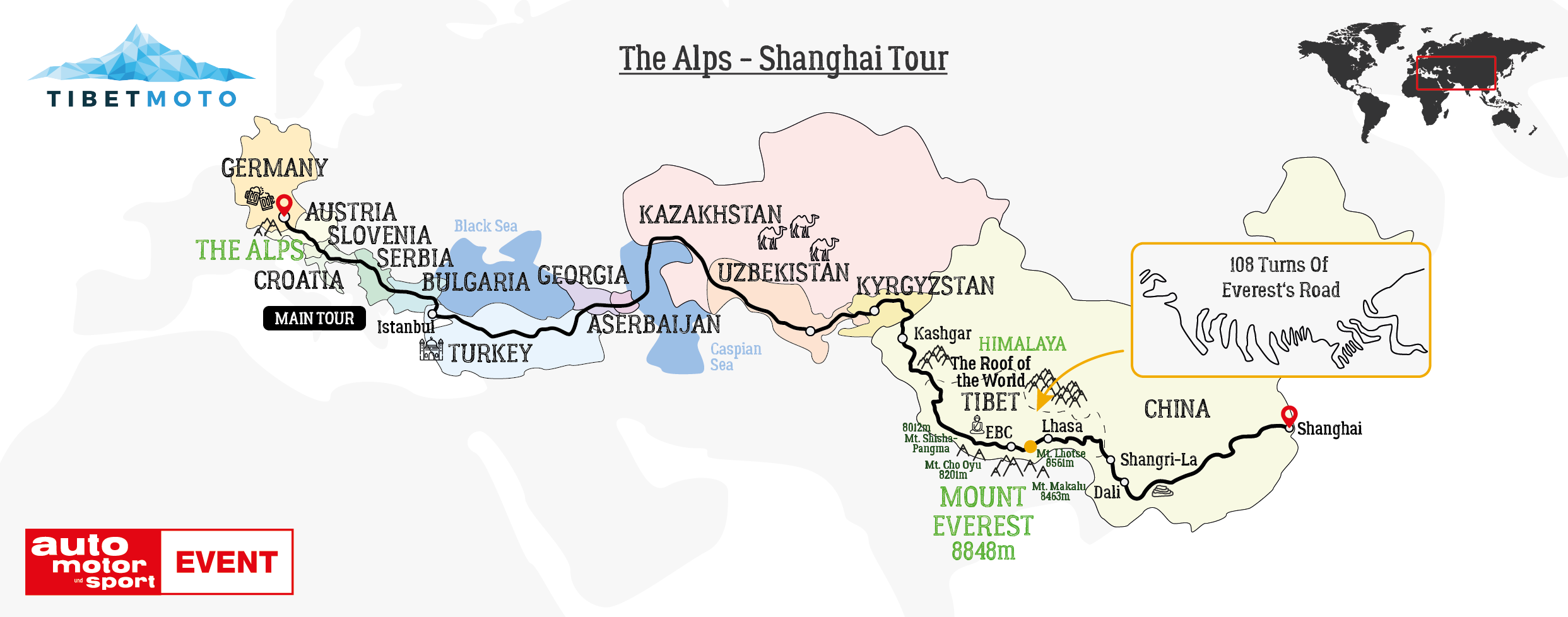
This motorhome tour is an adventure of superlatives: starting from the shores of the Bavarian Chiemsee, the route stretches across the Balkans, Anatolia, and the Black Sea coast into Central Asia, finally reaching the distant metropolis of Shanghai. Over the course of more than 80 travel days, participants will experience the fascination of the historic Silk Road. Traveling primarily on paved roads with occasional challenging sections, you will traverse vast steppes, shifting deserts, and majestic high mountain ranges, discovering legendary sites such as Samarkand, the Taklamakan Desert, Tibet, and Lhasa.
From Europe to Central Asia – the traces of the Silk Road
The starting point at Lake Chiemsee marks the beginning of a once-in-a-lifetime overland adventure. Your motorhome journey leads through the Balkan nations to Istanbul, the “Oriental Pearl” on the Bosphorus. After crossing the Anatolian Highlands, the route follows the Georgian Black Sea coast and the rugged peaks of the Caucasus Mountains toward the Caspian Sea.
In Uzbekistan, we trace the steps of ancient traders along the Silk Road. The historic trade hubs of Bukhara and Samarkand captivate visitors with their monumental mosques, madrasas, and vibrant bazaars. The expedition continues into Central Asia, passing through fertile regions like the Fergana Valley before reaching the border of Kyrgyzstan. As you transition between the plains and the first mountain ridges, the landscape shifts dramatically into the nomadic highlands of the Tian Shan. From here, the route opens up toward China and the vast expanses of the Asian high plateaus.
Read more
Qinghai: High Plateaus and the Landscapes of Northwest China
In China, the first stages lead through remote northwestern regions and into the breathtaking scenery of the Qinghai Plateau. Between barren plains, salt lakes, and highland steppes, the sheer scale of this region is truly impressive. As the altitude increases, the landscape and climate change noticeably, with the route gradually ascending into the Tibetan Highlands. While the journey primarily utilizes well-maintained roads, certain sections require heightened driver focus.
Through the Tibetan Highlands to Lhasa
The route continues through the high-altitude regions of Qinghai and Tibet, passing vast steppes, nomadic settlements, and secluded valleys. Multiple mountain passes and long stretches at over 4,000 meters define this leg of the transcontinental journey. Finally, you reach Lhasa, the spiritual heart of Tibet—a place whose unique atmosphere and cultural significance represent a major highlight of the tour. Alongside pilgrims, the group will explore the alleys of the Old Town and visit the Potala Palace, the former residence of the Dalai Lama. This stage is deeply characterized by centuries-old traditions and a profound cultural heritage, serving as an emotional peak for many participants.
From Yunnan to Shanghai
Leaving the high plateaus behind, the route winds through the mountain landscapes of Eastern Tibet and over spectacular mountain passes toward Yunnan. Deep valleys, snow-capped peaks, and narrow gorges dominate this section before the scenery softens. Yunnan offers a striking contrast: lush vegetation, milder temperatures, and culturally diverse regions define the stages through Shangri-La, Lijiang, and Dali. Historic old towns and traditional architecture make this part of the trip truly special.
Heading further east, the route traverses the varied landscapes of Southern and Central China. Karst mountains, river valleys, and spectacular natural backdrops—such as Zhangjiajie—accompany the path to the Three Gorges Dam on the Yangtze River. The final stretch follows major river systems through densely populated regions until reaching Shanghai—one of Asia’s most dynamic metropolises and the official finish line of this extraordinary journey.
Extend the expedition – to Bangkok
If Shanghai isn’t far enough for you, there is an optional extension for this overland motorhome tour: travel south through Laos and Vietnam into Thailand, continuing the adventure all the way to Bangkok.
AT A GLANCE
 |
08.08. – 01. 11.2027 | ||||
 |
|
||||
 |
85 days / 84 nights |
||||
 |
Participants stay in their own motorhomes or expedition vehicles. |
The Alps – Shanghai Overland Highlights
- Istanbul – Bridge Between Europe & Asia
A full day to explore one of the most fascinating metropolises in the world. Where East meets West – mosques, bazaars, alleys, and history. - UNESCO World Heritage in Anatolia: Safranbolu
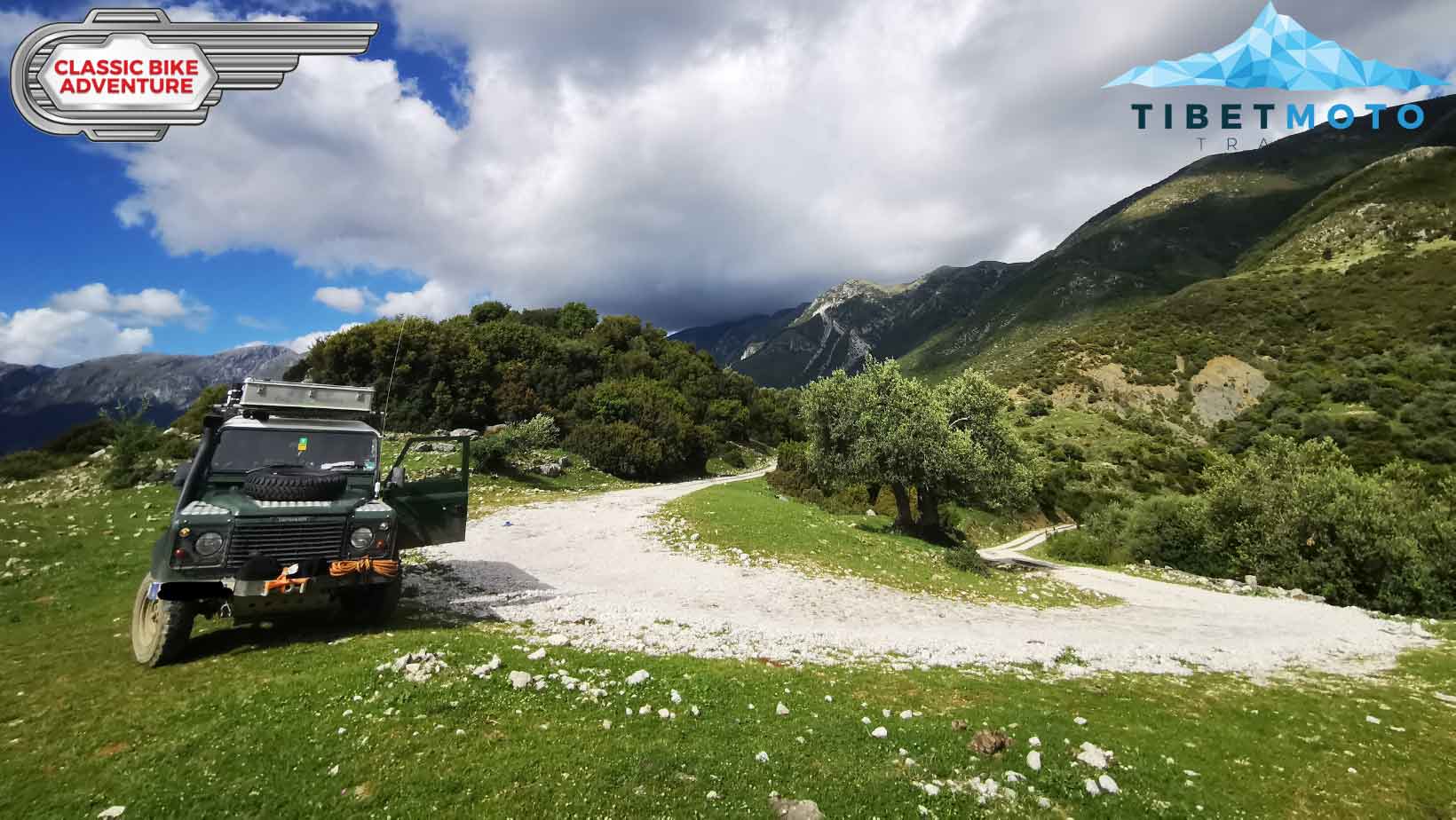
A historic Silk Road town with timber-framed houses, bazaars, and rich history – a hidden gem of Anatolia. - The Greater Caucasus & the Steppes of Kazakhstan
Through Georgia’s wild mountain landscapes and Kazakhstan’s endless plains – a blend of challenge, nature, and freedom. - Oases of the Silk Road – Samarkand, Khiva & Bukhara
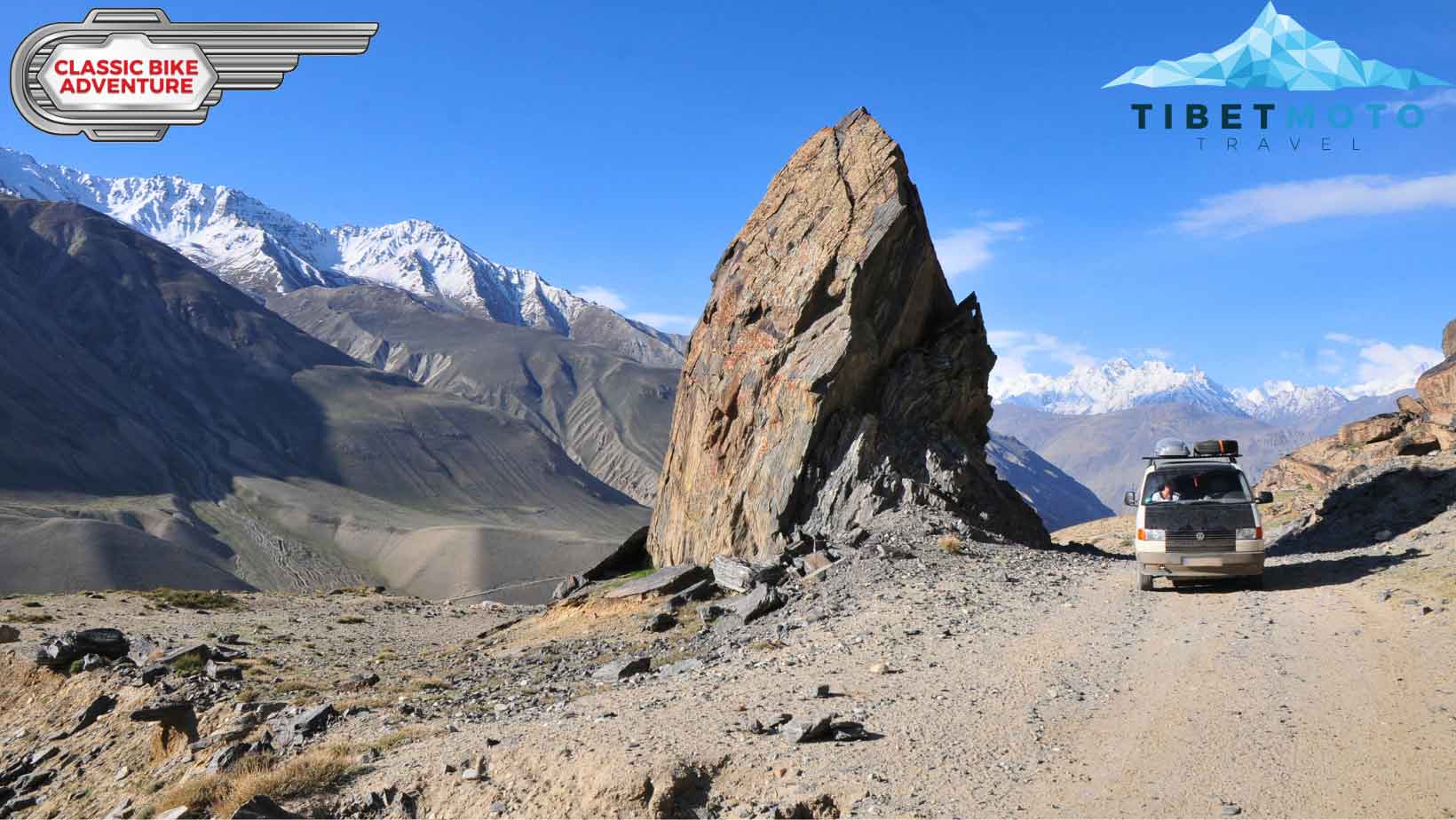
Three magnificent cities of Central Asia with oriental architecture, lively bazaars, and time for guided city tours. - Kyrgyzstan – Caravan Routes & Mountain Trails
Untouched landscapes, ancient nomadic paths, yurts, and pure nature. - Tibet & the Everest Base Camp
Across the legendary Torugart Pass into the highlands of Tibet – up to the Everest Base Camp with views of the world’s highest peaks. - Lhasa, Xigaze & Gyangze – The Heart of Tibet
Visits to Lhasa, the Potala Palace, Jokhang Temple, and the historic sites of the Himalayas. - Yunnan & South China – Tiger Leaping Gorge, Shangri-La & Dali
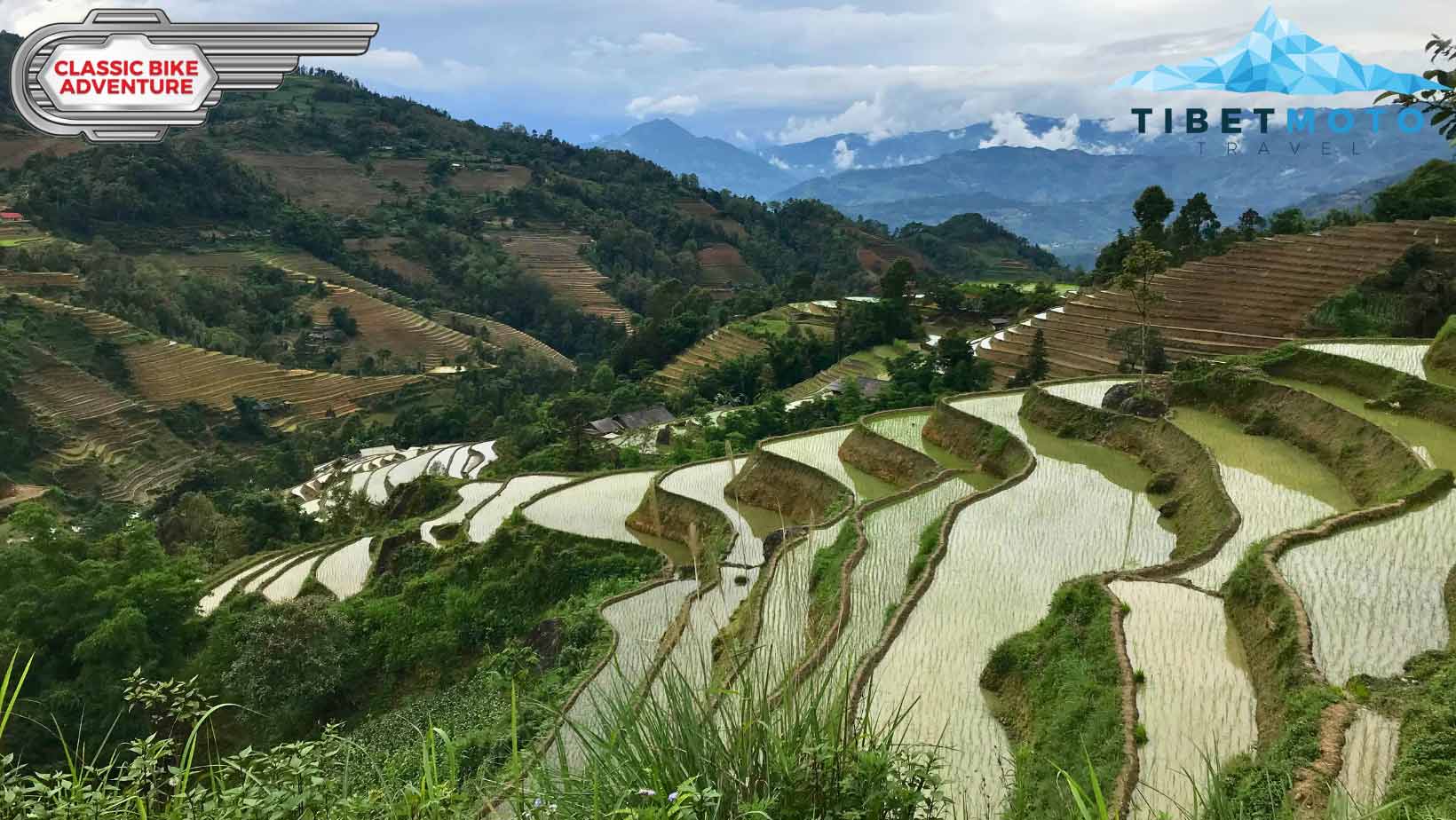
Rice terraces, Tibetan-Buddhist villages, deep gorges, and UNESCO-listed towns – the dramatic contrasts of southern China. - Finale in Shanghai – Metropolis at the End of the Journey
The journey ends in the vibrant city of Shanghai: modern skyline, colonial old town, the Bund – and reflections on an unforgettable adventure.


The route is mostly well-maintained and paved. Two-lane roads alternate with small, sometimes single-lane mountain roads. Drivers should be accustomed to safely navigating hairpin turns and narrow, quickly changing curves. Highways are not taken.
Some sections, up to full day stages, are unpaved. In addition to good gravel roads, some stretches may have potholes and bumps. Certain areas may be covered with sand or pebbles, and there are moderate inclines on unpaved road surfaces. The off-road/paved ratio is approximately 20/80.
Including breaks, photo stops, and sightseeing, but excluding a lunch break, which lasts about one hour. On regular days, we start in between 8-9am and arrive at the tour hotel in the afternoon. Average times: Approximately 6-7 hours per day
The Alps to Shanghai




The Alps to Shanghai – Itinerary
Day 1: Chiemsee / Traunstein
The journey begins on the shores of Lake Chiemsee. The group meets amidst the Bavarian Alpine foothills, where final preparations are made and everyone gathers for a detailed briefing. The route, organizational procedures, and important information for the coming days are discussed. In this tranquil setting, nestled between the lake and the mountains, an initial atmosphere of optimism and shared determination emerges – the starting point for a long journey southeast.

Day 2: Chiemsee – Zagreb
The next morning, the group sets off. From Lake Chiemsee, the route leads out through the Alpine foothills, past green valleys and wooded ridges. The border with Austria is soon reached, and the landscape becomes more mountainous. Via Salzburg and further towards Carinthia, the road winds through the Alps, accompanied by distant views of peaks and deep valleys. Tunnels and passes alternate until the crossing into Slovenia opens behind Villach. The scenery changes noticeably: rolling hills, vineyards, river valleys. Kilometer by kilometer, Croatia draws closer until we reach Zagreb – a city where Central European architecture blends with southern vibrancy. The old town with its squares, churches, and cobblestone streets invites us to take a first evening stroll after the long stage, before settling down on the outskirts of the city.
Distance: approx. 430 km, Croatia
Day 3: Zagreb – Sabac
From Zagreb, the route continues east. Soon, the Croatian landscape opens up into vast plains, crisscrossed by fields, small villages, and rivers. The road is quiet, the distances become longer, and with each kilometer, the anticipation of the next border crossing grows. The Sava River heralds Serbia, where the atmosphere changes noticeably. The roads are simpler, the towns more pristine, and the landscape appears vast and open. In the afternoon, the group rolls into Sabac, a city on the banks of the Sava, considered the gateway to the Serbian interior.
Distance: approx. 400 km, Serbia
Day 4: Sabac – Nis
From Šabac, the route continues southeast. Initially, the vehicles follow the vast plains of the Sava River, with fields and small villages dominating the landscape. Gradually, the hills gain height, and the road begins to wind in long curves through a diverse landscape. The journey remains entertaining, as open spaces alternate with wooded sections, and views of the region’s river valleys repeatedly emerge. The closer the group gets to Nis, the more clearly the character of the southern Serbian highlands becomes apparent. Here, at the transition between the fertile plains in the north and the rugged foothills of the Balkans, lies the destination: a square just outside the city.
Distance: approx. 320 km
Day 5: Nis – Tsigov chark
The next morning, we continue eastward from Nis, into the gradually changing landscape of southeastern Europe, to the border with Bulgaria, and then on to the tranquil retreat of Tsigov Chark. The area lies high in the Rhodope Mountains, virtually nestled in coniferous and mixed forests – a landscape that becomes quieter and more open with every kilometer covered. Tsigov Chark lies at an altitude of approximately 900 to 1,000 meters and overlooks the Batak Reservoir. Nestled in the Rhodope Mountains, the lake attracts anglers, hikers, and those seeking peace and quiet alike. Ski resorts, hiking trails, and the open sky make it a popular destination year-round. The group finds their overnight accommodation here.
Distance: approx. 320 km, Bulgaria

Day 6: Tsigov chark – Istanbul
From Tsigov Chark, the route continues: across the border, through the mountainous heart of Bulgaria, into the vast Thracian Plain, and on to Istanbul. This stage represents a shift in aesthetics: from the moderate serenity of the mountains through hilly transitional regions to the plain, which suddenly open up to reveal endless fields, historic cities, and the beginnings of the urban chaos of the metropolis. In the early evening, the group reaches the outskirts of Istanbul – a city that divides continents and connects worlds. Between Europe and Asia, an ancient urban structure unfolds here, where Ottoman minarets, Byzantine walls, and modern silhouettes blend into one another.
Distance: approx. 440 km, Turkey
Day 7: Istanbul
After the long journey through Eastern Europe, today offers the opportunity to experience Istanbul in full. The vehicles will stop, and the group will be transferred to the historic center of the metropolis. Here, where Europe and Asia meet, a city experience of exceptional depth unfolds. The day begins with a visit to the Hagia Sophia, whose monumental dome has dominated Istanbul’s skyline for centuries. Once a Byzantine church, later a mosque, and now once again a religious center, it impressively conveys the stratification of cultures and eras.
Read more
Directly opposite stands the Blue Mosque, whose delicate minarets and blue-tiled interiors are among the most important landmarks of the Islamic world.
A walk leads the group to the Hippodrome, the former center of public life in ancient Constantinople. Between obelisks, columns, and expansive squares, the area’s former importance becomes tangible. Finally, the group delves into the labyrinth of the Grand Bazaar – a market that, with its narrow alleys, vaulted ceilings, and thousands of stalls, represents a world of its own. Scents, voices, and colors blend here to create a unique sensory experience.
In the afternoon, the group returns home. The day in Istanbul leaves the group with the feeling of having wandered through millennia of history in just a few hours – a contrast to the tranquil landscapes of the previous days and an unforgettable highlight of the trip.

Day 8: Istanbul – Safranbolu
We leave the European side of Istanbul and head into Asia, into the Anatolian hills, where the roads soon disappear into wooded valleys. The group follows the route to Safranbolu, a picturesque town whose Ottoman half-timbered houses and winding alleys offer a striking glimpse into past centuries. Safranbolu has been a UNESCO World Heritage Site since 1994 thanks to its half-timbered houses. Nestled on the slopes of a verdant landscape, the town feels like an open-air museum that has managed to retain its authenticity to this day.
Distance: approx. 470 km
Day 9: Safranbolu – Kurtulus
Today, a longer stage of the journey awaits: In the morning, the group continues to a camp near Kurtulus. The vehicles leave the main roads and travel along smaller routes, passing villages, fields, and forests. At the destination, a simple, natural spot awaits the group, located directly on the coast and sheltered by trees for a peaceful evening.
Distance: approx. 530 km

Day 10: Gölge Camp –Yusufeli
An early start is recommended today as well. The route is longer and leads through a challenging mountainous landscape, where tunnels, bridges, and switchbacks determine the flow of the road. A large part of the route can be driven along the Black Sea coast, which fascinates with its changing panorama of steep cliffs, small bays, and green mountain slopes.
A stop in Trabzon – a lively port city with a long history, which is an excellent place for a lunch break – is particularly worthwhile. Here, you can explore the narrow streets or enjoy a view of the Black Sea before the group heads further inland. The climb into the Artvin province is impressive: rugged valleys, narrow roads, and views of the rivers that have cut deep into the rock. Yusufeli itself is surrounded by mountains and conveys the feeling of having travelled far away from the main roads.
Distance: approx. 450 km
Day 11: Yusufeli – Cildir
The journey to Cildir takes the group to northeastern Turkey. The roads wind through plateaus and secluded valleys, past small villages and expansive pastures filled with the clear mountain air. With every kilometer, the landscape becomes more barren, yet also more impressive – a transition that already makes the proximity to the Caucasus tangible. The destination lies here – Lake Cildir, a tranquil body of water at almost 2,000 meters above sea level, framed by rolling hills and open spaces. The sky is reflected in its vastness, and the lake’s mood changes depending on the light and weather – sometimes calm and smooth, sometimes turbulent and rough. The campsite is located near the lake. From here, the view extends to the mountains on the border with Georgia, which are not far away.
Distance: approx. 250 km
Day 12: Cildir – Achalziche/Abastumani
From Cildir, the group sets off for Georgia. Although the distance is manageable, crossing the border requires time and patience – formalities and checks dominate the day. However, as soon as the vehicles reach Georgian soil, the atmosphere changes significantly: the valleys appear greener, the roads more vibrant, and the panorama of the mountains heralds the route ahead. The destination is Abastumani, a small town in the hills of the Lesser Caucasus, known for its clear air and healing springs. The access to the observatory above the town offers a welcome change of scenery.
Read more
The route runs along a narrow, partly unpaved track, offering the four-wheel drive vehicles their first real off-road experience in Georgia. Switchbacks wind through forested slopes until the domes of the observatory finally come into view. The spot at the top not only offers impressive views of the mountains, but also a special atmosphere—far from the main roads, in a place that combines science, nature, and tranquillity. This is where the group spends the night.
Distance: approx. 150 km, Georgia
Day 13: Abastumani / Akhaltsikhe – Tbilisi
The route runs northeast through vast high plateaus and along the Kura Valley. Barren hills, agricultural land, and occasional monastery complexes accompany the path. Upon entering Tbilisi, the group reaches the country’s political and cultural center—a city where Persian, Russian, and Caucasian influences overlap.
Distance: approx. 210 km

Day 14: Tbilisi
Today is available for exploring Tbilisi. Those who wish can take a tour of the Old Town, leading through narrow alleys past traditional houses, churches, and the famous sulfur baths. Viewpoints and walks along the Kura River offer ever-changing perspectives. Cafés, restaurants, and wine bars invite you to experience the Georgian way of life and end the day in a relaxed atmosphere. While we visit Tbilisi, the vehicles are prepared for shipping across the Caspian Sea and transported to Baku.
Day 15: Flight to Baku / Ferry
The group follows the vehicles by flying to Baku, from where the ferry departs to cross the Caspian Sea.
Azerbaijan

Day 16-18: Ferry Crossing of the Caspian Sea
We cross the Caspian Sea by ferry. After a few days on the water, the group feels solid ground beneath their feet again as they clear customs and enter Kazakhstan.
Kazakhstan
Day 19: Aktau – Beineu
The drive from Aktau to Beineu leads through the vast, arid landscapes of Western Kazakhstan. For the most part, the road runs dead straight through semi-desert and steppe, accompanied by endless horizons and a profound sense of immense space. This section of the expedition highlights the raw, untouched beauty of the Central Asian wilderness.
Distance: approx. 460 km
Day 20: Beineu – Jasliq
Leaving Beineu, we head south through the vast and arid landscapes of Central Asia. The road cuts through open steppe and desert terrain, where the horizon seems endless and settlements are few and far between. With every kilometer, the surroundings become more remote and untouched, until we eventually cross the border into Uzbekistan. By the end of the day, we reach Jasliq, a remote settlement in Karakalpakstan that offers a striking glimpse into life far from the main travel routes.
Distance: approx. 250 km
Day 21: Jasliq – Moʻynoq
The next day, the route leads to Mo’ynoq, on the former shores of the Aral Sea. The landscape becomes more barren, the wind carries dust over vast expanses once covered by water. In Mo’ynoq itself, the rusting ships now lying on dry sand bear witness to the region’s dramatic environmental history. The group spends the night nearby and has the opportunity to experience the scene of the stranded wrecks – a deeply moving place that reveals the extent of human intervention in nature.
Distance: approx. 270 km

Day 22: Moʻynoq – Khiva
From here, the group continues to Khiva. The route is long, but leads to one of the great pearls of the Silk Road. The group reaches their quarters on the outskirts of the city and has plenty of time the following day to explore the oasis town at their leisure.
Distance: approx. 380 km
Day 23: Khiva
A day’s rest in Khiva offers views of the unique city walls, ornate minarets, and palaces. The historic old town of Itchan Kala, with its blue tiles and narrow streets, is considered one of the most impressive ensembles in Central Asia.

Day 24: Khiva – Gazli
The next stage takes the group to Gazli, a smaller town away from the major tourist crowds. We spend the night here, eagerly anticipating tomorrow’s journey to legendary Bukhara.
Distance: approx. 330 km
Tag 25: Gazli – Bukhara
From Gazli, it’s only a short journey to Bukhara. The day’s drive has been deliberately planned to allow plenty of time to experience this city at its leisure – one of the great pearls of the Silk Road. Bukhara is a place where you can practically feel the Silk Road – in the architecture, in the voices in the bazaars, and in the atmosphere that hovers between past and present. Within the old town, mosques, madrasas, and bazaars are located close together, connected by narrow alleys that tell of life in bygone eras.
Read more
Particularly impressive is the Kalyan Minaret, which has towered over the city’s rooftops since the 12th century and is considered one of the landmarks of all of Central Asia. Labi-Hauz Square, with its shady mulberry trees, invites you to absorb the hustle and bustle of the city, while caravanserais and ornately decorated madrasas reflect the former wealth of the trading city.
Distance: approx. 110 km

Day 26: Bukhara – Samarkand
Finally, the route leads to Samarkand. The name alone conjures up images of splendour and history. After driving through the Uzbek countryside, the city rises with its famous Registan Square, domes, and minarets. Samarkand represents the legacy of Timur Lenk, monumental architecture, and the feeling of being at the center of the history of the Silk Road. This marks the end of a sequence of stages that leads us through the cultural highlights of Central Asia.
Distance: approx. 280 km
Day 27: Samarkand
A day of rest in Samarkand offers the opportunity to explore Tajikistan’s neighbouring Uzbekistan at leisure. From the very first step into the old town, you can sense why Samarkand has been considered a jewel of the Silk Road for centuries. Here, power, art, and spirituality combine in a striking way. The center of the city is the Registan, a square surrounded by three madrasas, which, with its turquoise domes and ornate facades, resembles a stage. But Samarkand has much more to offer: The Gur-Emir Mausoleum reflects the ambitions of Timur, whose rule originated here. The Shah-i-Zinda Necropolis, with its densely packed tombs, appears almost like a kaleidoscope of Islamic architecture, while the Bibi-Khanym Mosque, once one of the largest in the world, offers a glimpse into the past with its imposing ruins.
Read more
What makes Samarkand special today is the juxtaposition of past and present. Between the venerable monuments of the Silk Road rises a modern city with wide boulevards, new parks, and contemporary architecture. Modern cafes, universities, and shops demonstrate that Samarkand is not just an open-air museum, but a vibrant metropolis that carries its historical role as a hub of exchange into the present. This interplay of ancient history and modern everyday life gives the city a dynamism that makes it unique in Central Asia.

Day 28: Samarkand – Tashkent
From Samarkand, the route continues northeast through the vast plains of Uzbekistan. The stretch runs through agricultural regions where fields, small villages, and scattered rows of trees shape the landscape. As you approach Tashkent, the settlements become denser before finally reaching the capital of Uzbekistan. As the country’s largest city, Tashkent blends historical Silk Road influences with modern urban development.
Distance: approx. 310 km
Day 29: Tashkent – Kokand
The route leads eastward from Tashkent toward the Fergana Valley. The path crosses the foothills of the Tian Shan Mountains and traverses a pass before the landscape changes dramatically. From Kokand, the route continues through the Fergana Valley. The landscape is characterized by intensively farmed agricultural land, orchards, and numerous settlements situated densely along the road.
Andijan lies in the eastern part of the valley near the border with Kyrgyzstan and serves as an important economic center for the region. The proximity to the mountains is already palpable here.Beyond the mountains, the fertile Fergana Valley opens up—one of the most densely populated and agriculturally significant regions in Central Asia. Kokand is located in the western part of this valley and was once a major hub along the Silk Road.
Distance: approx. 240 km
Day 30: Kokand – Andijon
From Kokand, the route continues through the Fergana Valley. The landscape is characterized by intensively farmed agricultural land, orchards, and numerous settlements situated densely along the road. Andijan lies in the eastern part of the valley near the border with Kyrgyzstan and serves as an important economic center for the region. The proximity to the mountains is already palpable here.
Distance: approx. 130 km
Day 31: Andijion – Osh
The stage continues eastward from Andijan and crosses the border into Kyrgyzstan. Leaving the Fergana Valley, the scenery changes noticeably: the route ascends into the foothills of the Alay Mountains and becomes increasingly dominated by mountains and valleys. Osh, one of the oldest cities in Central Asia, sits at the edge of the Fergana Valley and marks the transition into the high-mountain landscapes of Kyrgyzstan.
Distance: approx. 70 km, Kyrgyzstan
Day 32: Osh
A rest day in Osh offers the opportunity to visit the old town, the bazaar and Suleiman Mountain or simply use the time to take care of some errands.

Day 33: Osh – Toktukul Lake
From Osh, the route continues northeast, into the mountains of Kyrgyzstan. The road follows the course of the Naryn River until it finally opens into the enormous water basin of the Toktogul Reservoir. Unlike high-alpine mountain lakes formed by glaciers, Lake Toktogul is a man-made reservoir – created by the construction of the Toktogul Dam in the 1970s.
But this very artificiality also offers a special charm: the water stretches deep blue and wide between bare, steep mountains, shimmering in shades of gold and red in the changing sunlight. On the west shore, near the small town of Torktel, the group finds a suitable place to spend the night. Here, with an unobstructed view over the water, the scenery conveys a special atmosphere – rugged, impressive, and characterized by a vastness that is typical of Kyrgyzstan.
Distance: approx. 280 km
Day 34: Toktukul Lake – Kyzyl-Oi
From the shores of the Toktogul Reservoir, the road winds into the mountains, past gorges, wide valleys, and free-roaming herds of horses. With every bend, new vistas open up, revealing green slopes and rugged peaks, dotted with small settlements and yurts. At the end of the stage lies Kyzyl-Oi, a remote village in the “Red Valley,” whose slopes glow reddish in the evening light. Here, in simple guesthouses amidst the pristine mountain landscape, the group experiences authentic village life in Kyrgyzstan.
Distance: approx. 270 km

Day 35: Kyzyl-Oi – Moldo Ashuu
From Kyzyl-Oi, you have the option of driving the Moldo-Ashuu Pass. The route is both challenging and impressive, as it leads high into the mountains with sweeping views of green valleys and barren peaks. You’ll spend the night near Ak-Terek, where traditional Kyrgyz yurts dominate the landscape.
Distance: approx. 160 km
Day 36: Moldo Ashuu – Tash Rabat
Finally, the group reaches Tash Rabat. This historic caravanserai complex, secluded in a high valley, serves as a striking reminder of the time when Silk Road caravans rested here. The stone walls of the old caravanserai, surrounded by green meadows and towering mountains, provide an atmospheric conclusion to these stages through the heart of Kyrgyzstan. They also signal the imminent crossing of the border into China and the onward journey to Tibet, where a completely new world of culture and high mountains awaits the group.
Distance: approx. 210 km
Day 37: Tash Rabat – Border station near Kashgar – Kashgar
From Tash Rabat, the crossing into China begins – a section that requires both adventure and patience. The road climbs up to the Torugart Pass, one of the crossings between Kyrgyzstan and the Middle Kingdom. With every kilometer, the route becomes rougher, the asphalt giving way to potholes and dirt roads, until finally, only an adventurous gravel road marks the way. At the top of the pass, at an altitude of over 3,700 meters, the Kyrgyz-Chinese border awaits the group. After entering the country, we initially drive down, but the vehicles are not allowed to continue directly to Kashgar: they are parked about 120 kilometers away from the customs station. From here, an organized transfer takes the group to the city in the afternoon, while the vehicles are not picked up until the following morning.
Distance: approx. 220 km, China
Day 38: Kashgar
The following day is dedicated to formalities in Kashgar. Temporary Chinese driver’s licenses and license plates are issued at the local traffic office. A brief medical check and vehicle inspection are also required. These procedures take time, and the organization is a collective effort – patience is the most important virtue on this day.
Distance: approx. 150 km

Day 39: Kashgar
An additional day in Kashgar will be reserved in case the process takes longer. For the group, however, this isn’t just a wait, but an opportunity to experience one of the most fascinating cities on the ancient Silk Road. The old town, with its mud houses, winding alleys, and colorful markets, conveys a sense of Kashgar’s centuries-old importance as a caravan hub. In the evening, the city comes alive: vendors, music, aromas, and the famous grilled meat, which is considered some of the best in China, make the stay an experience that makes the bureaucratic part of immigration disappear.
Day 40: Kashgar – Aksu
From Kashgar, the route continues east to Aksu. The landscape along the route already reveals the typical contrasts of the Tarim Basin: arid plains, sand and stone deserts on one side, and the towering Tianshan Mountains beyond. The roads are well-maintained, yet the landscape seems almost endless. Aksu itself is a modern city with a Uyghur character.
Distance: approx. 460 km

Day 41: Aksu – Kuqa
The next day, the group rolls to Kuqa. This section begins the long journey along the northern route to Lhasa. Kuqa, once an important stop on the ancient Silk Road, is known for its Buddhist caves and historic temples, testifying to the region’s cultural richness.
Distance: approx. 370 km
Day 42: Kuqa – Korla – Boston Lake
From Kuqa, we continue to Korla and from there to Boston Lake, China’s largest inland lake. The water shimmers blue and turquoise, surrounded by a barren, semi-desert landscape—a striking contrast that defines the charm of this region.
Distance: approx. 350 km
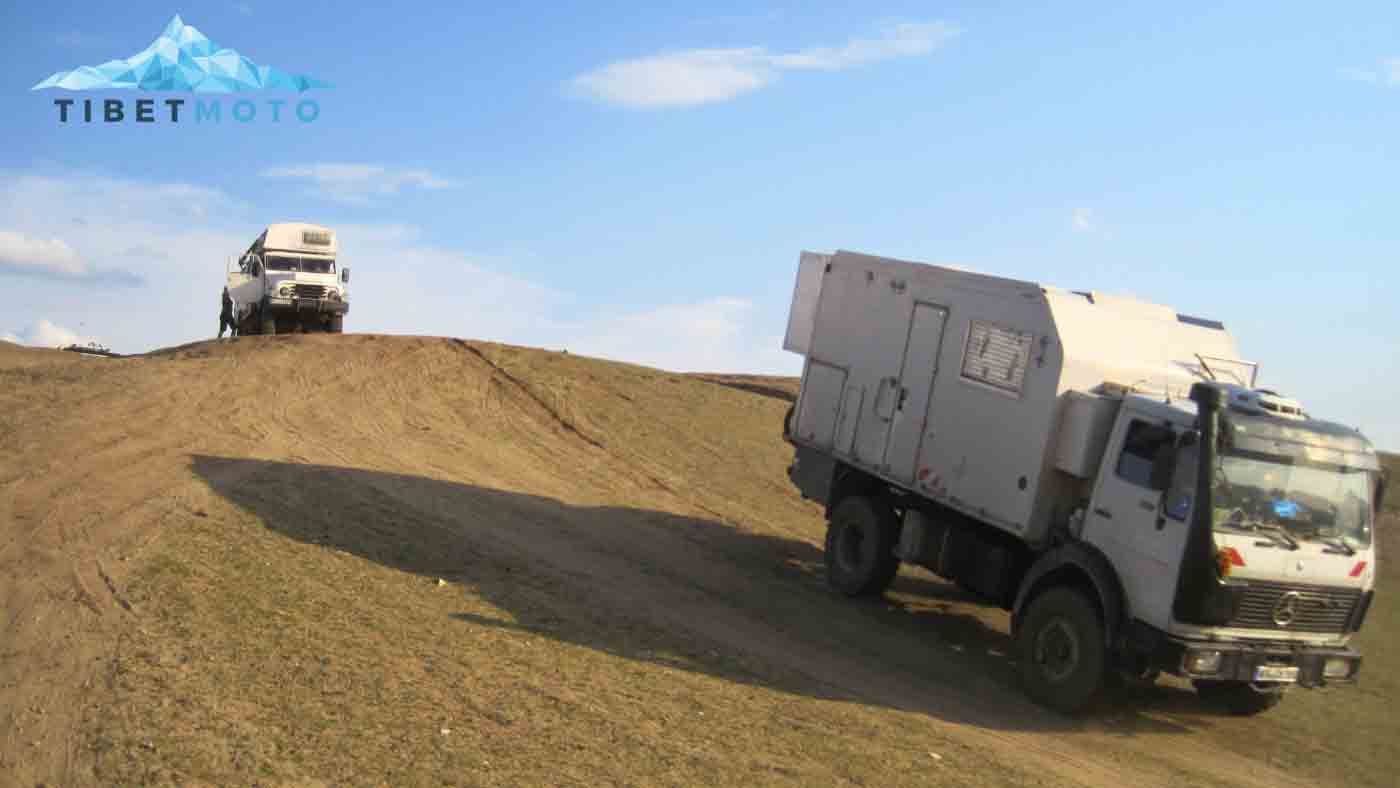
Day 43: Boston Lake – Turpan
The next leg of the journey takes the convoy to Turpan, an oasis town on the edge of the Taklamakan Desert. The climate is extreme; in summer, Turpan is one of the hottest places in all of China, but the fertile soils surrounding the town allow for the cultivation of wine, melons, and fruit. From here, some of the region’s most important sights can be explored the following day.
Distance: approx. 340 km
Day 44: Turpan
A rest day in Turpan offers the opportunity to intensively explore one of the most fascinating oasis cities on the Silk Road. Here, on the edge of the Taklamakan Desert, extreme climatic conditions combine with millennia-old cultural history. The group visits the ruins of Yarkhoto (Jiaohe), an abandoned mud settlement that impressively testifies to the size and importance of this region in ancient times. Also on the itinerary are the Astana Tombs, with their artfully preserved wall paintings and grave goods, which offer a direct glimpse into the life of bygone eras. The Buddhist caves, with their frescoes, also illustrate the cultural exchange that once took place along the trade routes. Finally, the journey to the Flaming Mountains, whose bright red rocks appear to glow in the sunlight, is impressive – a sight that makes Turpan a highlight on the route through Xinjiang.
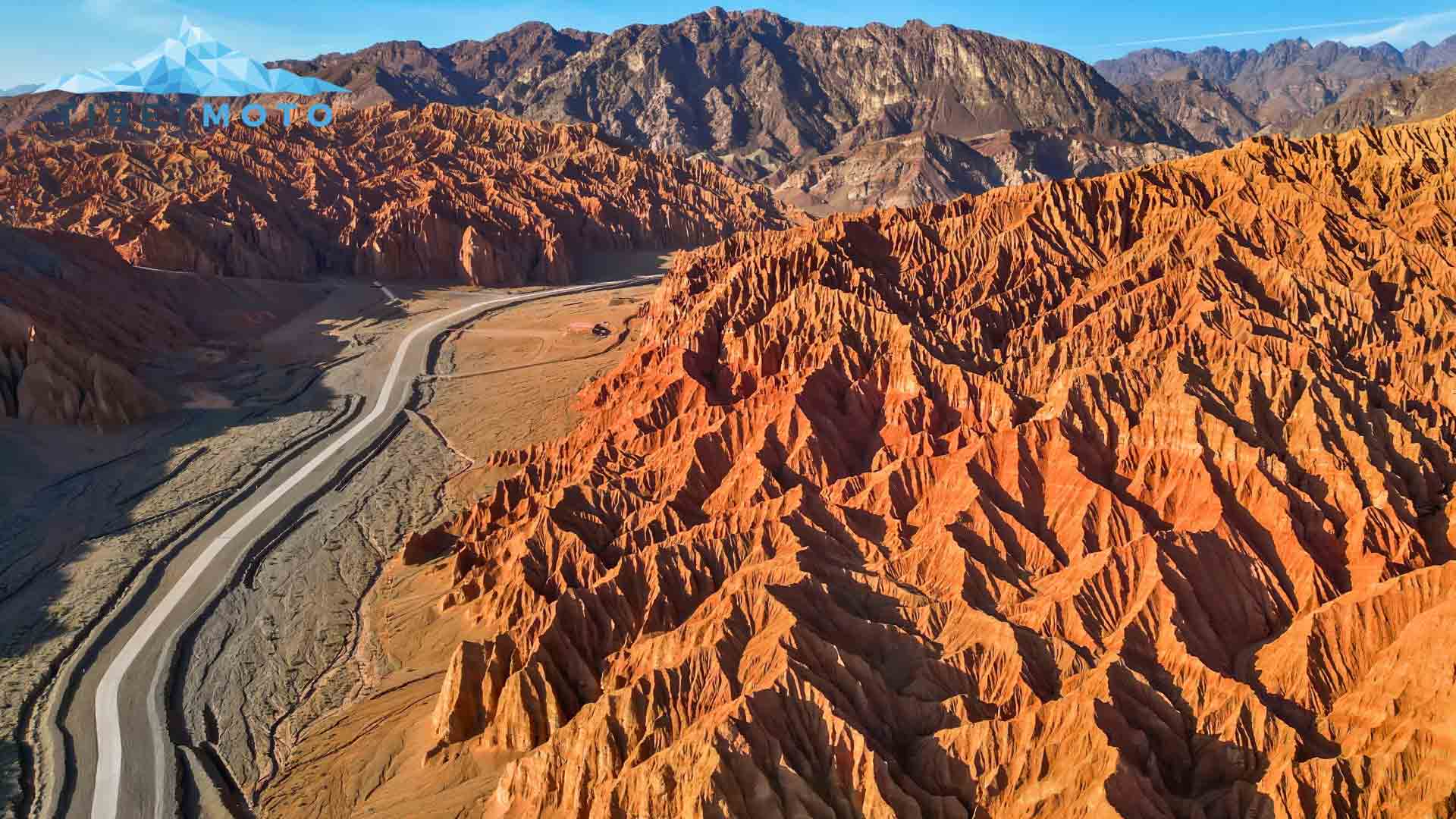
Day 45: Turpan – Hami
From Turpan, the route continues to Hami, another oasis town on the historic Silk Road. Here, where desert and mountains meet, the sequence of stages through Xinjiang continues in an atmosphere of contrasts and history—a harbinger of this adventurous journey that will lead to Tibet.
Distance: approx. 410 km
Day 46: Hami –Dunhuang
From Hami, the route continues east to Dunhuang, a city on the western edge of the Gobi Desert, located in the so-called Hexi Corridor. Even the approach conveys the character of this region: barren plains, wind-carved dunes, and the rocky outcrops of the Hexi Corridor, which has marked the trade route between China and Central Asia for centuries. Due to its location, Dunhuang is still considered the gateway to the great deserts.
Distance: approx. 410 km
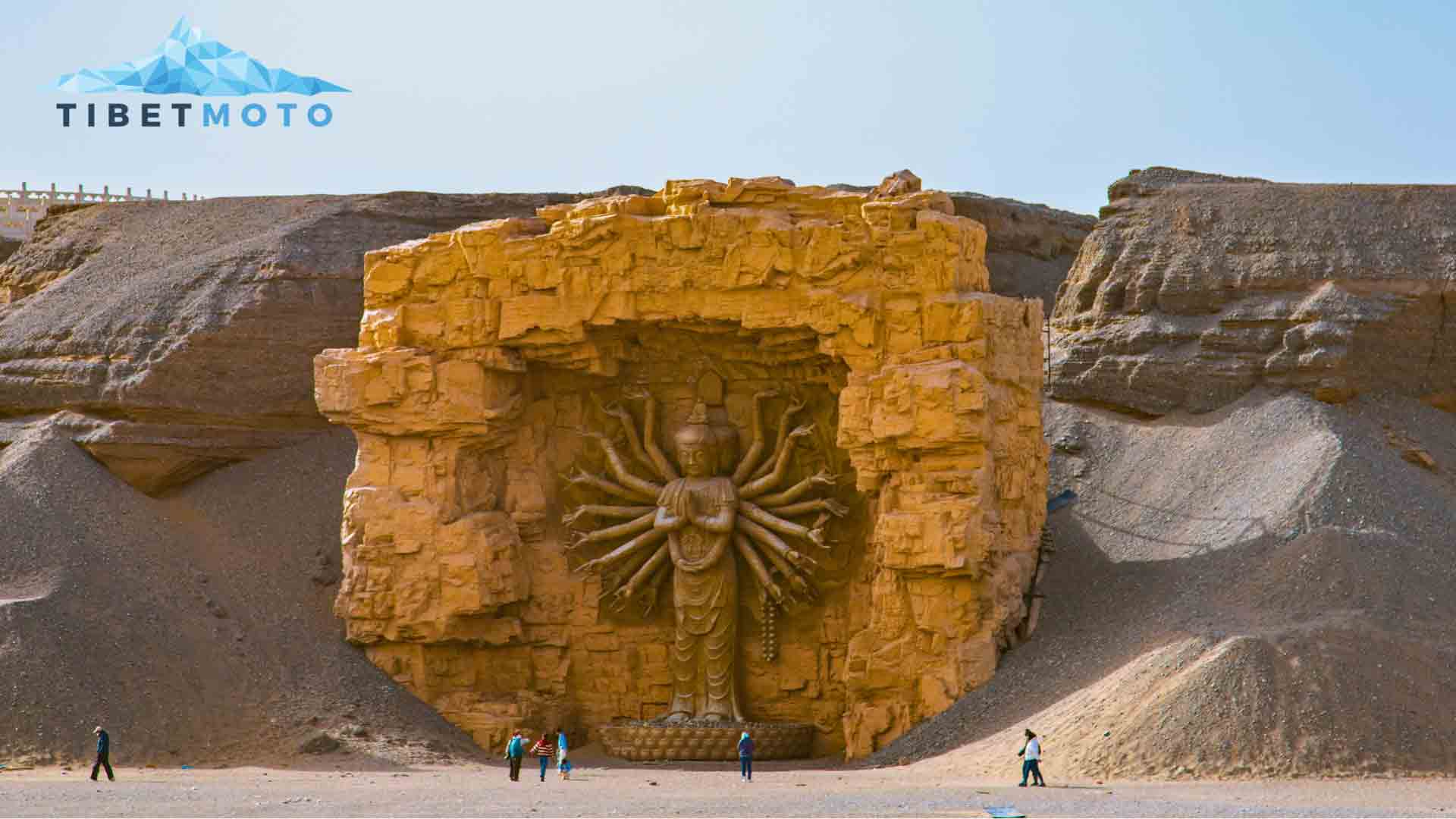
Day 47: Dunhuang
A rest day in Dunhuang offers the opportunity to experience this city on the edge of the Gobi Desert off the beaten track. Once an important hub on the Silk Road, today it impresses with lively bazaars, traditional alleys, and the contrast between sand dunes and oases. Highlights include the Mogao Grottoes, a UNESCO World Heritage Site with thousands of Buddhist murals, as well as the up to 170-meter-high dunes of Mingsha Shan, at the foot of which Crescent Lake lies, resembling a green jewel. Thus, on a rest day, Dunhuang combines the tranquility of the desert with cultural diversity and the bustling life of the city—before the journey continues.
Day 48: Dunhuang – Haixi
From Dunhuang, the route continues westward into the vast landscapes of the Qaidam Basin. The road passes through barren desert and steppe regions, while the journey gradually climbs onto the heights of the Qinghai Plateau. As the distance from the Silk Road oasis increases, the scenery becomes ever more expansive and rugged: rocky deserts, salt lakes, and seemingly endless plains define this remote highland region at elevations of around 2,700 to 3,000 meters. At the end of the stage, the group reaches the Haixi region — a sparsely populated area in the heart of the Qaidam Basin.
Distance: approx. 550 km
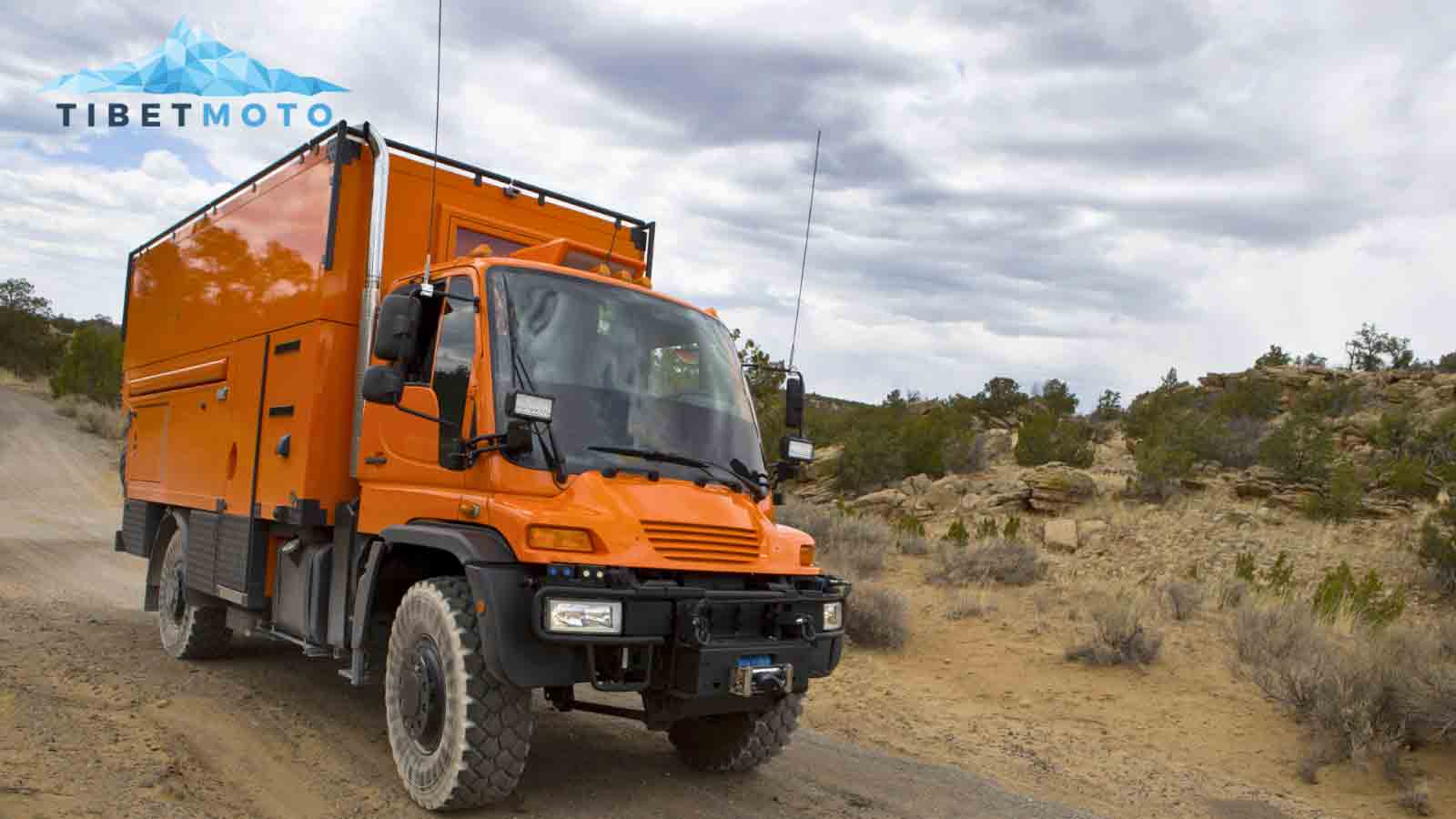
Day 49: Haixi – Dulan County
From Haixi, the route continues through the vast landscapes of the Qaidam Basin. The stretch initially leads through dry plains and semi-deserts before the landscape gradually changes. With increasing altitude, the barren areas transition into the wide grasslands of the Qinghai Highlands. Dulan County is located on the southeastern edge of the Qaidam Basin at around 3,100 meters above sea level and marks the transition to the higher regions of the Tibetan Plateau.
Distance: approx. 330 km
Day 50: Dulan County – Madoi County
The route leads further south and rises significantly into the high altitudes of the Tibetan Plateau. The landscape becomes increasingly open and pristine: vast highland steppes, small lakes, and occasional nomadic settlements characterize the image of this remote region. Madoi County lies at over 4,000 meters above sea level and belongs to the Sanjiangyuan region, the source area of several major Asian rivers, including the Yellow River.
Distance: approx. 280 km
Day 51: Madoi County – Yushu
From Madoi, the route continues through the highland landscapes of the Qinghai Plateau. The route runs across wide plateaus and through gentle mountain ranges, while small lakes and watercourses repeatedly interrupt the landscape. As you approach Yushu, parts of the route follow the valleys of the upper reaches of the Yangtze River. Yushu is located at approximately 3,700 meters above sea level and is considered an important cultural center of the Tibetan-influenced region.
Distance: approx. 330 km
Day 52: Yushu
The stay in Yushu offers the opportunity to recover from the long highland stages and to further acclimate to the altitude. The city is located in a wide valley on the upper reaches of the Yangtze River and is a significant center of Tibetan culture in Qinghai. Monasteries, prayer flags, and the wide highland landscapes characterize the surroundings. The rest day allows the group to check vehicles, replenish supplies, and experience the special atmosphere of this region.
Day 53: Yushu – Riwoqe
From Yushu, the route leads further toward Tibet and over several highland passes into the remote areas of the Chamdo region. The road follows wide valleys and open plateaus, while the landscape increasingly shows itself characterized by grass steppes and mountain ranges of the Tibetan Highlands. With the border crossing into Tibet, the architecture and culture of the region also change significantly. Valley of the Yarlung Tsangpo.
Distance: approx. 380 km
Day 54: Riwoqe – Sog
The route leads further through the vast highland regions of Northeast Tibet. Open steppe landscapes, broad valleys, and occasional river courses characterize the route through this sparsely populated region. Nomadic settlements and wide grazing lands define the image, while the road leads through the impressive expanse of the Tibetan Plateau.
Distance: approx. 400 km
Day 55: Sog – Nagqu
The stage leads through the high steppes of the Changtang Highlands, one of the most remote regions of Tibet. Vast grasslands, small lakes, and occasional nomadic settlements characterize the image of this region at over 4,500 meters above sea level. Nagqu is considered an important center of this highland region and a traditional meeting point for the nomads of the Changtang.
Distance: approx. 230 km
Day 56: Nagqu – Lhasa
From Nagqu, the route leads further south toward Lhasa. The road crosses several highland passes and follows wide valleys, while the landscape slowly changes and appears increasingly structured. As you approach Lhasa, the settlements become more dense before finally reaching the historic capital of Tibet—a cultural and spiritual center of the Tibetan Highlands at approximately 3,650 meters above sea level.
Distance: approx. 340 km
Day 57-59: Lhasa
A rest day in Lhasa allows you to experience the city more fully. At the Bharkor Market, pilgrims, traders, and travelers throng through alleys full of scents and colors. Towering above all is the Potala Palace, the former residence of the Dalai Lama, whose white and red walls dominate Lhasa’s skyline. Equally important is the Jokhang Temple, the spiritual center of Tibet and a destination for countless pilgrims from all parts of the highlands.

Day 60: Lhasa – Gyantse – Shigatse
From Lhasa, the route first leads west over several highland passes and along the turquoise Yamdrok Lake, which is one of the sacred lakes of Tibet. The road then follows wide valleys and open highland landscapes before reaching the historic city of Gyantse, which is one of the culturally significant places in the region with its impressive Dzong and the Pelkor Chöde Monastery. Further west, the route runs through the fertile valley of the Yarlung Tsangpo and finally reaches Shigatse. Tibet’s second-largest city is situated at an altitude of approximately 3,800 meters and is traditionally an important religious and cultural center of the region.
Distance: approx. 330 km
Day 61: Shigatse
A rest day in Shigatse offers time to visit the Tashilhunpo Monastery, founded in the 15th century and still considered the seat of the Panchen Lama. The sprawling complex, with its golden roofs, red walls, and winding courtyards, is a highlight of any trip to Tibet. Inside are enormous statues, including the 26-meter-tall Maitreya Buddha—the largest gilded statue of its type in the world. Pilgrims circumambulate the monastery walls on the kora path, accompanied by fluttering prayer flags and the sound of prayer wheels.
Read more
But Shigatse offers even more: The old town surrounding the monastery, with its markets, craft shops, and traditional houses, offers an authentic picture of Tibetan life. Here, you can discover finely woven carpets, intricate thangka paintings, and silver jewelry. The Shigatse Dzong fortress, which towers high above the city, also reminds us of the political importance of the place – it was once the residence of regional rulers and today offers a wide view over the Yarlung Tsangpo valley.
Day 62: Shigatse – EBC
From Shigatse, the route leads along one of the most spectacular roads in Tibet, if not the world. With countless twists and turns, it climbs to passes that offer a panorama of the highest mountains on earth. From here, the view extends to the mighty eight-thousanders Shisha Pangma, Cho Oyu, Lhotse, Makalu – and, of course, Everest itself. After a stopover in Tingri, the journey continues until reaching Rongbuk Monastery at an altitude of almost 4,900 meters. The final kilometers to the monastery are not permitted in private vehicles – instead, a local transfer takes over the final section.
Read more
Even though the actual base camp has been inaccessible since 2019, Rongbuk offers an unparalleled view of the 8,848-meter-high summit. The unobstructed view of Everest is a moment that rewards all the effort. The overnight stay is not far from the parked vehicles, amidst the rugged high mountain landscape of the Himalayas.
Distance: approx. 290 km

Day 63: EBC – Sakya
From the heights of Everest Base Camp, the route leads back over the winding roads of the Himalayas to Sakya. This place is famous for its monastery, whose massive gray walls almost resemble a fortress and are a marked departure from the otherwise mostly whitewashed Tibetan monasteries. Sakya is considered the spiritual center of its own Buddhist school, and with its ancient libraries and halls, it conveys a sense of deep history and spirituality.
Distance: approx. 200 km
Day 64: Sakya – Shigatse
From Sakya, the route continues through the wide valleys of southern Tibet. The landscape is characterized by open plateaus, small settlements, and agricultural areas along the Yarlung Tsangpo Valley. As you approach Shigatse, the settlements become more frequent before finally reaching Tibet’s second-largest city once again.
Distance: approx. 150 km
Day 65: Shigatse – Shannan
The route leads eastward from Shigatse through the wide valleys along the Yarlung Tsangpo. The journey passes through agriculturally dominated regions of southern Tibet, where small villages, fields, and monasteries blend into the highland landscape. Shannan is considered one of the most culturally significant regions of Tibet. Some of the country’s oldest monasteries were founded in this area, and many places are regarded as the cradle of Tibetan culture.
Distance: approx. 410 km
Day 66: Shannan – Nyingchi
From Shannan, the route continues eastward along the valleys of the Yarlung Tsangpo toward Nyingchi. As the distance from the central high plateau increases, the landscape changes noticeably: the valleys become greener, forests cover the mountain slopes, and the climate feels significantly milder than in the high steppes of central Tibet. Nyingchi is situated at an altitude of about 3,000 meters and is one of the most vegetation-rich regions of Tibet. Forested slopes, fertile valleys, and a comparatively mild climate give the region its very own character and form a clear contrast to the barren highland landscapes of the previous stages.
Distance: approx. 400 km
Day 67: Nyingchi – Ranwu Lake
From Nyingchi, the group crosses various mountain passes reaching elevations of up to 5,100 meters before reaching Lake Ranwu, a turquoise-blue body of water amidst snow-capped mountains and dense forests. The journey there offers repeated views of river valleys and peaks – a striking interplay of high mountains and lush vegetation that highlights the diversity of the Eastern Himalayas. The region is therefore also known as the “Switzerland of the Orient.”
Distance: approx. 370 km
Day 68: Ranwu Lake – Zogang
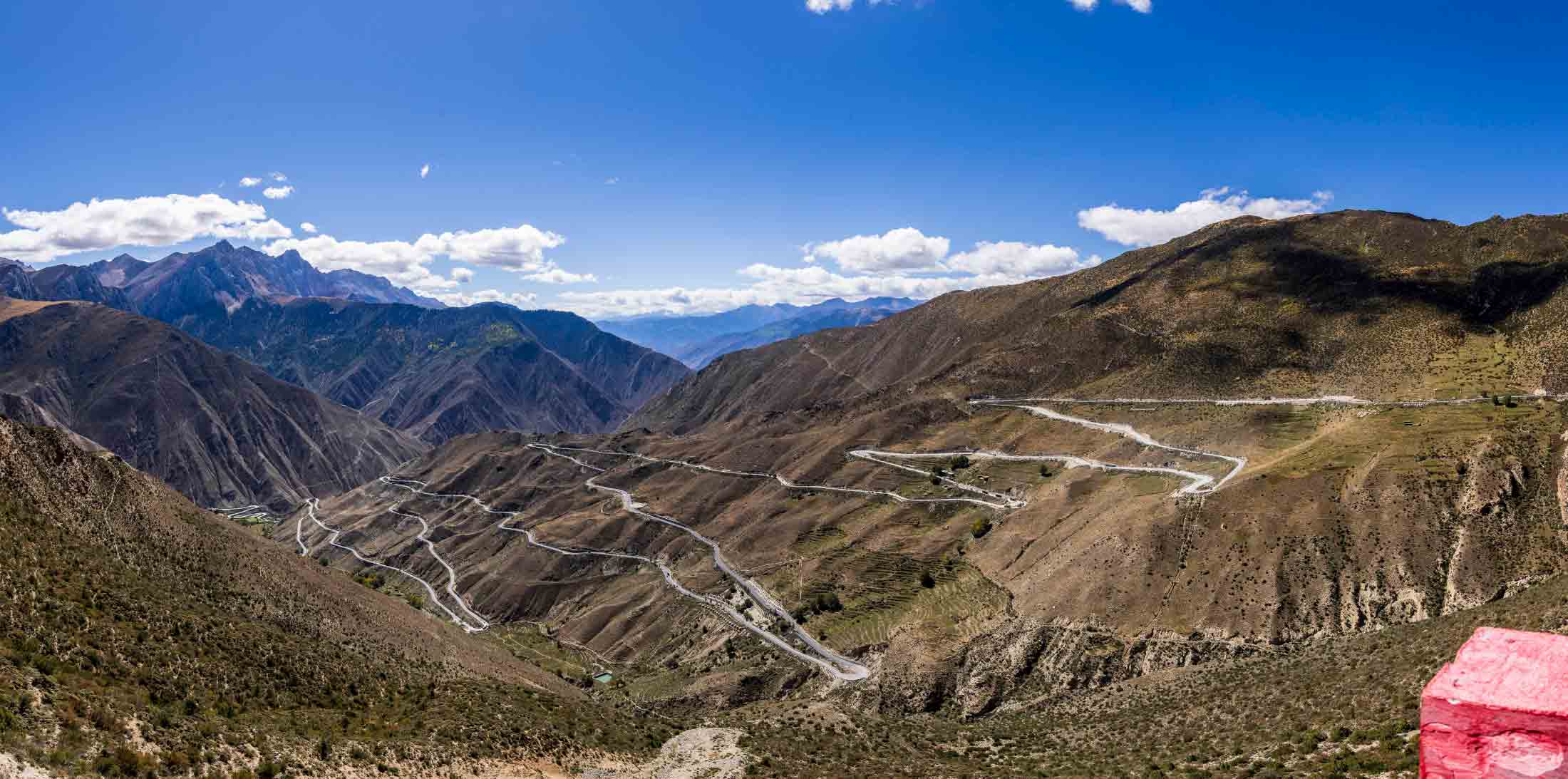
We follow the road along the lakeshore toward Zogang. The first part of the day leads through narrow gorges where the river has cut deep into the rocks. A driving highlight awaits: the infamous Snake Pass, known to locals as the “Road of 72 Bends.” The route winds its way up to over 4,300 meters in endless switchbacks. Each section offers new perspectives on the wide-open valley, the snow-capped peaks in the distance, and the seemingly endless succession of hairpin bends.
Once at the top, the pass rewards us with a sweeping view of the mountains of eastern Tibet before the road descends again in long loops. This passage is one of the most impressive stretches of the entire trip—a mixture of technical challenge and dramatic scenery that will stay with you forever.
Distance: approx. 300 km

Day 69: Zogang – Markham
From Zogang, the journey continues to Markham, a key transportation hub on the eastern edge of Tibet. This is where the routes to Yunnan and Sichuan converge. The journey there leads through gorges and across high plateaus, past nomad camps and pastures. Markham is less characterized by its sights than by its role as an interface between the cultures and roads of the Eastern Himalayas.
Distance: approx. 160 km
Day 70: Markham – Feilaisi
The next day, the group reaches the Jiabe Homestay via remote roads. The stage is shorter but scenic: small river valleys, villages, and fields dominate the landscape. A stay in a traditional homestay offers the opportunity to experience everyday Tibetan life up close – a glimpse into the lives of the people who have lived here for generations amidst a barren mountain landscape. The cozy accommodation is located at an elevation of approximately 1,900 meters, within walking distance of a magnificent viewpoint of the Mekong Gorge.
Distance: approx. 240 km

Day 71: Feilaisi – Shangri-La
From the homestay, the route continues to Shangri-La. This name evokes the image of a mythical “hidden paradise.” The city is located in Yunnan Province and marks the transition from the Tibetan plateau to a region with a more strongly Chinese influence. Monasteries, markets, and the blend of Han and Tibetan culture make Shangri-La a special stopover. Small, two-story wooden houses with detailed carvings adorn the beautiful old town, lending the place a unique atmosphere.
Distance: approx. 190 km
Day 72: Shangri-La – Tiger Leaping Gorge – Lijiang
Another highlight follows the next day: the drive through the Tiger Leaping Gorge on the way to Lijiang. The Jinsha River rushes between three-kilometer-high cliffs, flanked by the mighty chain of the Jade Dragon Snow Mountain, which towers over 5,500 meters. This dramatic landscape is one of the deepest gorges in the world and offers a first-class natural experience. In the evening, the group reaches Lijiang, whose UNESCO-protected old town, with its winding canals, bridges, and traditional Naxi houses, offers an incomparable atmosphere. This day also marks the end of the Tibetan phase of the trip—now the immersion in Naxi culture begins.
Distance: approx. 190 km

Day 73: Lijiang
A rest day in Lijiang allows you to explore the old town more intensively, stroll through narrow alleys and enjoy the mix of history and lively everyday life.
Day 74: Lijiang – Dali
From Lijiang, it’s only a short drive to Dali. The old town, with its well-preserved Ming Dynasty city wall and the famous Three Pagodas of Chongsheng Temple, is a significant testament to its history. Excursions by boat or bike around Erhai Lake are ideal, while the Cangshan Mountains beckon with hiking trails and a cable car. In the evenings, the lively Huguo Street, also known as “Foreigner Street,” creates a vibrant atmosphere with its restaurants, cafés, and shops.
Distance: approx. 180 km

Day 75: Dali – Kunming
From Dali, the journey continues to Kunming, the capital of Yunnan Province. The route travels briskly along the highway, while the landscape is characterized by alternating mountains, valleys, and agricultural plains. Kunming, known as the “City of Eternal Spring,” welcomes the group with a mild climate and a vibrant blend of tradition and modernity.
Distance: approx. 400 km
Day 76: Kunming – Xingyi
The next stage takes the group to Xingyi, where the Qianxinan karst region dominates the landscape. Rugged limestone formations, deep gorges, and verdant hills create an impressive backdrop, emphasizing that the journey now shifts to the subtropical south of China.
Distance: approx. 280 km
Day 77: Xingyi – Guiyang
From Xingyi, the route leads to Guiyang, the capital of Guizhou Province. The city is located in a hilly region and is known for its ethnic diversity – numerous minorities live here, whose culture and markets enrich the cityscape.
Distance: approx. 340 km
Day 78: Guiyang – Fenghuang
The onward journey to Fenghuang takes the group to one of China’s most beautiful ancient towns. Situated directly on the river, with wooden houses built on stilts, narrow alleys, and traditional stone bridges, Fenghuang exudes a unique historic charm. Here, time seems to have stood still.
Distance: approx. 370 km

Day 79: Fenghuang – Zhangjiajie
From Fenghuang, we continue to Zhangjiajie, a region known worldwide for its bizarre sandstone formations. The steeply rising pillars and rock towers, often shrouded in mist, evoke a surreal fairytale landscape—and served as the inspiration for the floating mountains in the film “Avatar.”
Distance: approx. 210 km
Day 80: Zhangjiajie – 3 Gorges Dam
The next stage takes the group to the Three Gorges Dam on the Yangtze River. This gigantic structure is considered the largest hydroelectric power plant in the world and impresses with its immense dimensions, as well as its scenic location amidst the famous Three Gorges.
Distance: approx. 350 km

Day 81: 3 Gorges Dam – Wuhan
From here, we continue to Wuhan, one of the major metropolises of central China. Located at the confluence of the Yangtze and Han Rivers, the city combines modern architecture with historic sites, such as the Yellow Crane Tower. Wuhan also marks a clear step into the heart of the country—a melting pot of culture, history, and dynamism.
Distance: approx. 360 km
Day 82: Wuhan – Anqing
From Wuhan, the route continues east to Anqing, a city on the banks of the Yangtze River. The journey leads through densely populated areas with a constant alternation of towns, fields, and small hill ranges. Anqing itself is an ancient port city with a long history and, at the same time, a transportation hub that takes the group deeper into the economically important regions of eastern China.
Distance: approx. 360 km

Day 83: Anqing – Taihu Lake
The next day, we continue from Anqing toward Lake Taihu. It is one of China’s largest freshwater lakes, nestled in a gently rolling, fertile landscape, and has been considered a cradle of poetry, painting, and garden art for centuries. Its shores are dotted with tea plantations, fishing villages, and ancient water towns—a transition to the cultural landscapes that have made eastern China so famous.
Distance: approx. 390 km
Day 84: Taihu Lake – Shanghai Port
The final leg of the journey finally leads to the final destination: Shanghai. Along the way, the landscape becomes increasingly urban, and the silhouette of the metropolis announces the end of the long journey from afar. Shanghai, China’s vibrant economic metropolis, welcomes the group with a modern skyline, colonial architecture on the Bund, and an inexhaustible array of culture and life.
Distance: approx. 180 km
Day 85: Buffer day
A buffer day in Shanghai provides the opportunity to either explore the city – perhaps with a stroll along the Bund promenade, through the old town with its classical gardens, or through the modern Pudong financial district – or to take your time preparing for the shipping of the expedition vehicles.
Day 86: Shanghai
On the last day in Shanghai, the vehicles are loaded. The handover of the expedition vehicles marks the end of this incredible adventure, which led from the Alps through Central Asia, Tibet, and China to the Pacific coast. It’s a moment to reflect on thousands of kilometers full of impressions, encounters, and unforgettable landscapes. Not many people experience such a journey.

Your Most Unforgettable Car Adventure is just a Click away!
Book now your Roadtrip Eurasia Motorhome Journey Tour
Book NOW your „Roadtrip Eurasia Motorhome Journey Tour“!
Due to the high number of tour requests, you should decide quickly!
Our Next available tours are as follows:
2027
08.08. – 01.11.
Included Services
- All necessary parking and camping sites along the route are included in the tour price
- English-speaking tour guide with own vehicle.
- Mechanic accompanying the tour, universal tools, tire repair kit, etc.
- Rotating, local guides for numerous countries who speak the local language and are familiar with the culture. These countries include Turkey, Kazakhstan, Uzbekistan, Kyrgyzstan, and Tibet/China.
- Support vehicle for technical service.
- All official permits for Tibet/Temporary import of a foreign-registered vehicle into China:
– Temporary Chinese driver’s license
– Temporary Chinese license plate
– Deposit for the vehicle with Chinese customs
– Mandatory vehicle insurance
– Customs clearance upon entry and exit
– All permits for China and Tibet
– All official translations - State-approved and required Tibet guide (English-speaking) from the Chinese border and for the whole of Tibet
- All entrance fees according to the program
- City tours in Istanbul, Safranbolu, Amasya, Bukhara, Samarkand, Khiva, Kashgar, Lhasa, Dali, Shanghai
- Flight advice Shanghai – Europe at the end of the main trip
- Hotel parking costs (except Munich for organizational reasons)
- Support for entry into Turkey, Azerbaijan, the Central Asian states and China
Excluded Services
- Long-haul flight from Shanghai back to Germany
- Vehicle shipping from Shanghai to Hamburg at approximately €8,000-12,000 per vehicle, including all port and customs clearance fees.
- Gasoline/diesel, lunch and dinner, as well as snacks and beverages
- Travel cancellation insurance
- Car pickup in Hamburg after return shipping
- Visa fees
- Toll fees
- Vehicle insurance costs
Questions & Answers
Simple street maps are often available locally. The best road maps are available from the German publishers Reise Know How and Nelles. These are only available in specialized bookstores or online.
Your baggage will be carried by the support vehicle. Please don’t pack too much – remember: less is more. From time to time, we’ll have to carry our baggage over short distances to the hotel. Baggage is not insured, so please be sure to purchase your own baggage insurance for the trip if necessary. Your personal items for the day are best kept in the saddlebags or your daypack. Tank bags – including magnetic ones – can be used on the Enfields, but we don’t provide them.
Our European tour guides are skilled motorcyclists and inveterate travelers who love India. They’re resilient in the face of stress and know the history and culture of the regions they cover. Our Indian mechanics are experienced Enfield specialists who all speak English and are happy to help with any technical problem, great or small.
A stand-in rider is always available. More information on our travel concept is available here.
A travel day normally begins at 8 am with breakfast. Around 9 am, after a short briefing by the road captain, it’s time for the day’s riding, the mileage of which can vary quite a bit. Plenty of time will be available for lunch and coffee breaks, of course. Depending on the day’s mileage, we’ll reach the destination hotel between 3 and 4 pm.
Since our tours vary considerably, we may also hit the road at 8 am on high-mileage days – which is also nice, because then we have the whole day ahead of us.
Riding two-up is almost always possible. In difficult terrain or on rough tracks, every passenger has a guaranteed seat in the support vehicle to keep things relaxed for both rider and pillion.
Depending on the specific tour, the following bikes are available for our motorcycle tours in Tibet and China: The BMW models G 310 GS, F 800 GS and R 1200GS, as well as the Shineray X5, a 400cc single-cylinder enduro.
You will definitely want to bring your riding suit with protectors and a helmet. You will also need motorcycle boots or lighter riding shoes and gloves. While your gear should be breathable in hot climates, you need to be ready for anything at high altitudes and in the Himalayas. We recommend winter gloves, warm socks, liners for jackets and trousers, a scarf and face protection. Rain gear is a good idea if your riding suit is not waterproof.
Please note that we do not hire out clothing. We believe that your own riding gear will fit best and thus give you the best protection. If you forget anything, we’ll find a solution, however. We often have spare gear with us, or we can point you in the direction of a shop.
You will need your passport, national driving license, international driving license and flight ticket. Please be sure to make photocopies of all of your important travel documents and carry them separately. They can be invaluable in an emergency.
The deposit for the motorcycle varies depending on the choice of bike:
Shineray X5 400: EUR/US$ 500
BMW G 310 GS: EUR/US$ 1,000
BMW F 800 GS and R 1200 GS: EUR/US$ 1,500
Groups generally consist of 8 to 14 riders and 2 to 6 passengers. The minimum number of participants is 6 riders.
Yes, all passengers have a guaranteed seat. In bad weather or challenging riding conditions, they can switch to the support vehicle at any time – and back to the bike when conditions improve.
We always recommend that you take out travel insurance to cover costs incurred if you need to cancel the trip due to illness or other reasons. When shopping for travel health insurance, make sure the policy covers the potentially high cost of medical evacuation to your home country. Both forms of insurance can save you a lot of money in an emergency and we recommend them unreservedly. In many countries, your national motoring organization can provide the coverage you need.
All riders must have a valid motorcycle driving license issued in their home country. An international driving license is also required. Be sure to contact the relevant authorities in your home country well in advance for more information on obtaining an international driving license.
Entry/Visa:
Many nationalities can enter China visa free for up to 15 days. Those include:
Germany, France, Italy, The Netherlands, Spain, Malaysia, Switzerland, Ireland, Hungary, Austria, Belgium, Luxembourg, New Zealand, Australia, Poland.
Your passport must be valid for at least 6 months. Some other nationalities need a visa to enter China.
Should the duration of the stay exceed 15 days, you must apply for the visa yourself or hire an agency to do so. Due to frequent changes in the application procedure, we recommend using an agency. Although you can apply for the visa yourself, it is only slightly more expensive to hire an agency and often saves a lot of work. The visa for China costs approximately EUR 300. More detailed information on the visa can be found in a specific appendix after booking upon request.
Tour Concept by RC Hendrik
