




South of the Clouds Motorcycle Tour2025-11-22T10:54:26+00:00

South of the Clouds – Southwestern China Adventure

Along the Yangtze and Mekong into the Tibetan Himalayas

Our South of the Clouds motorcycle tour has been our most popular China motorcycle adventure since 2016. We have now redesigned it from the ground up, adding new panoramic mountain passes and remote backroads to create an even more exciting and varied Yunnan motorbike route through regions previously untouched by tourism. This journey includes some of the most dramatic highlights and best motorcycling roads in southwestern China. China is a vast country — roughly the size of the United States — ranging from immense deserts and grasslands to the towering peaks of the Himalayas and the bustling megacities of the east coast.

According to the travel guide publisher Lonely Planet, if you could visit only one province in China, Yunnan would be the obvious choice. Yunnan means “south of the clouds,” and from the perspective of Beijing, it lies at the distant southwestern edge of the country. Here you can still experience the authentic, traditional China that existed before rapid industrialisation — a compelling blend of pristine landscapes, minority cultures and ancient mountain trade routes.

The scenic richness, biodiversity and spectacular panoramic roads of Yunnan have impressed not only the Lonely Planet authors, but us as well — so much so that we established our first motorcycle office in Shangri-La over a decade ago. The landscape along this Yunnan motorcycle tour is so varied that riding through it feels like crossing an entire continent in just two weeks.

Read more

Yunnan borders Myanmar, Laos and Vietnam — a region defined by high Himalayan foothills, deep gorges and breathtaking rice terraces. The mighty Yangtze and Mekong rivers originate here, carving dramatic valleys through subtropical forests and alpine plateaus. The many ethnic minorities of Yunnan — from Naxi to Yi, Lisu, Mosu and Tibetans — have preserved their own distinct languages, traditions and spiritual practices. This cultural and geographic diversity forms a central part of the experience. The province’s highest point is the sacred Tibetan peak Kawa Karpo (6,740 m), while its lowest lies beside the Mekong at only 470 meters. Between these extremes, riders can expect endless twisty mountain roads, cultural highlights, ancient towns, fantastic regional cuisine and plenty of adrenaline along the way.

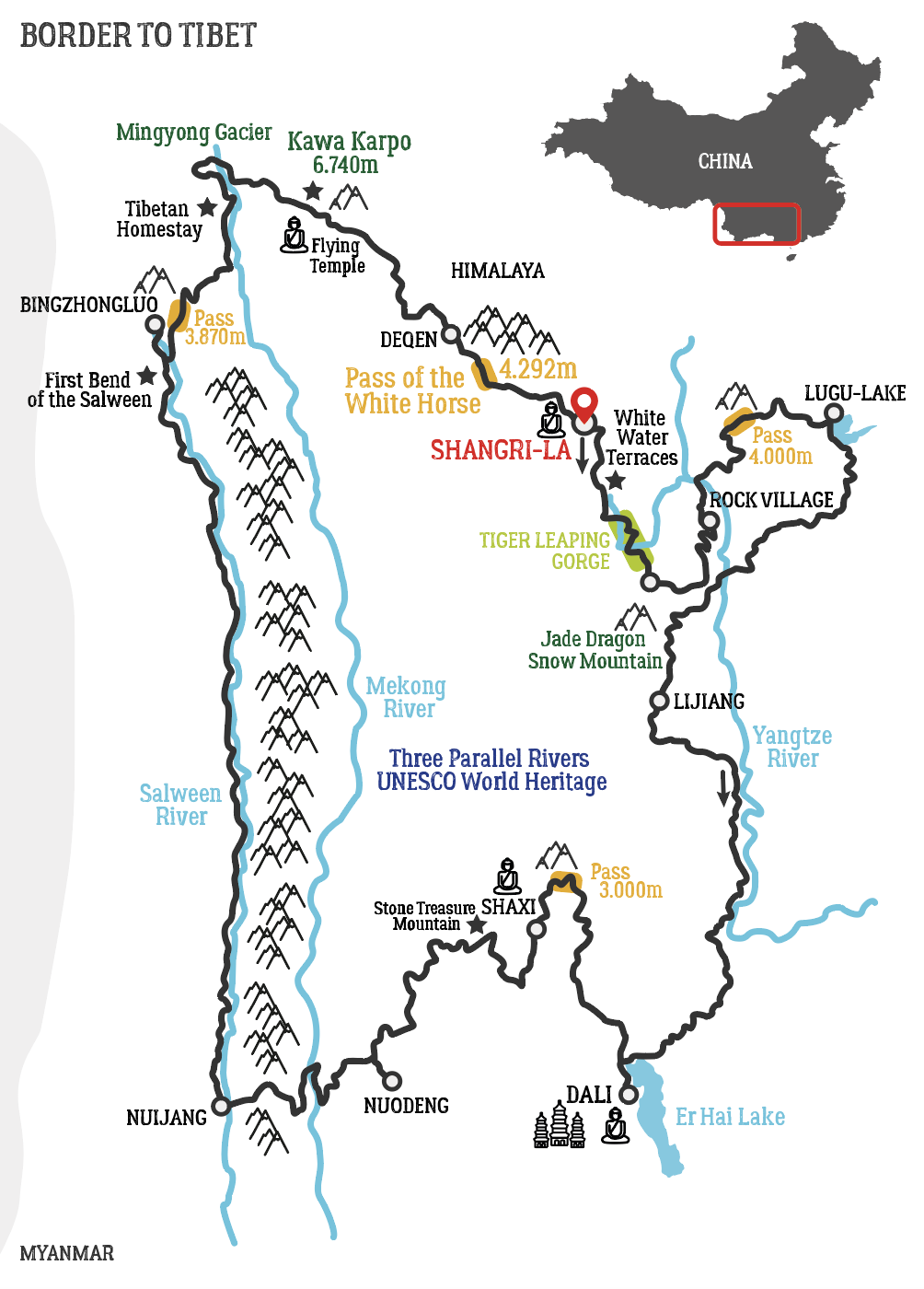
Our China motorcycle tour begins in the legendary town of Shangri-La, part of the Tibetan cultural regions in southwestern China. Shangri-La sits in a wide high-altitude valley surrounded by yak pastures and the first mountain ranges of the Himalayas. From here, we enter Tiger Leaping Gorge, one of the deepest gorges on Earth, framed by towering cliffs and a majestic 5,500-meter mountain chain. We then follow the Yangtze westward on a remote mountain road to a tiny stone village built high on a cliff — once a safe haven from marauding river pirates. After crossing a nearly 4,000-meter pass, we reach the turquoise Lugu Lake, surrounded by evergreen forest and home to the Mosu people.

Arriving in Lijiang, a UNESCO World Heritage old town at 2,600 meters, we have time to wander through its charming alleys, relax in small teahouses, or admire views of the towering Jade Dragon Snow Mountain that rises dramatically behind the valley. From there, we descend once again to the Yangtze, riding into a warm subtropical region where wheat fields give way to banana groves and tea plantations. Continuing along the Yangtze, we reach Dali, once the capital of an ancient kingdom and a major hub on the historic Tea Horse Road, which linked China with Myanmar and India. Dali lies between the 42-kilometre-long Erhai Lake and the 4,000-meter Cangshan Mountains. The following day is all about discovering the city at our own pace. We have many options such as visiting ancient and iconic monuments, the city’s majestic gates showcasing traditional architecture shaped by Feng Shui philosophy and much more.

We then climb the Cangshan mountains the following day and continue to the Salween (Nujiang) River, which rises in a remote corner of the Himalayas before flowing south into Myanmar. Following the river’s endless curves northward, we approach the Tibetan border and traverse a nameless high pass before descending into the upper Mekong gorge deep in the Himalayas. This region, inhabited primarily by Tibetans, offers rugged, moon-like landscapes and dramatic canyons. We stop in a green oasis hidden in a side valley and spend the night in a traditional Tibetan farmhouse, enjoying a rare insight into the daily life and culture of local families. The next day we explore the upper Mekong, the last of the Three Parallel Rivers of Yunnan — the Yangtze, Salween and Mekong — a UNESCO World Heritage nature reserve.

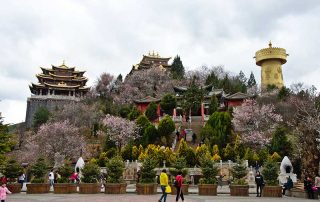
On the final riding day, we approach the highest and most spectacular stage of the journey, we ride narrow tracks and mountain gorges with incredible views of Kawa Karpo (6,740 m) before reaching the Mingyong Glacier, descending directly from the mountain’s summit. On our way back to Shangri-La, over hundreds of bends, we ascend the Pass of the White Horse — the highest point of the tour at 4,292 meters — before descending back into Shangri-La, arriving at the alleyways of the beautifully preserved wooden old town of Dukezong.

If you want to experience the authentic Middle Kingdom — far from crowded cities and standard tourist highlights — and explore a region of extraordinary natural beauty and cultural depth, this China motorcycle tour is for you. Join us and discover a side of China few travellers have ever seen.

You can also book our Guided South America Motorcycle Tour and savor breathtaking contrasts—from Amazonian rainforests and ancient Machu Picchu ruins to vibrant cities and soaring Andean peaks—offering an unforgettable adventure at every turn.

AT A GLANCE

Highlights South of the Clouds

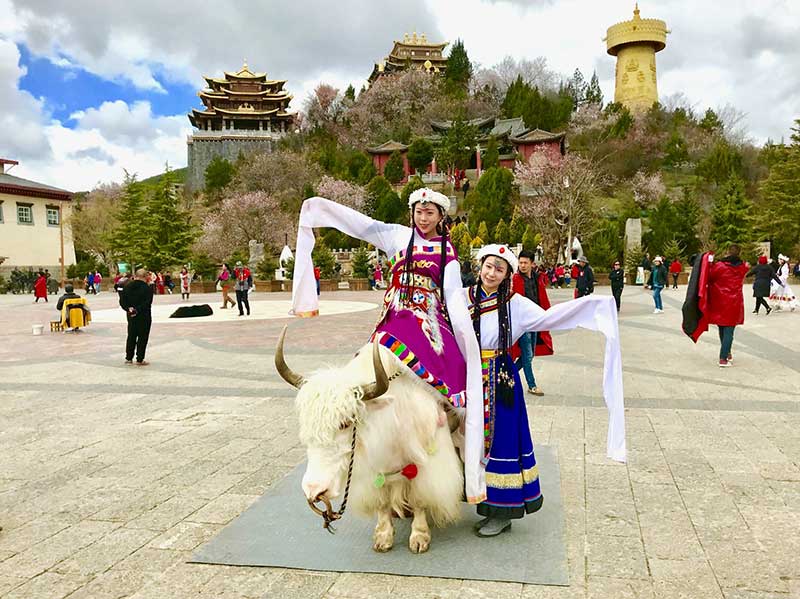
  • The entirely wooden old town of Shangri-La, home to the world’s largest Tibetan prayer wheel and a gateway to the Himalayas.
  • The Three Parallel Rivers of Yunnan — the Yangtze, Salween and Mekong — a UNESCO World Heritage nature reserve of extreme biodiversity and dramatic mountain landscapes.
  • The remote Tibetan regions of northern Yunnan, where high-altitude valleys, monasteries and snow-capped Himalayan peaks create one of China’s most striking cultural areas.
  • A spectacular route along the Salween River near the Myanmar border, including the high pass linking the Salween valley to the upper Mekong.
  • An overnight stay with a local Tibetan family in a small village overlooking the Mekong, offering a rare glimpse into traditional rural Tibetan life.
  • The UNESCO World Heritage town of Lijiang, framed by the 5,500-meter Jade Dragon Snow Mountain (Yulong Shan), one of the most famous landmarks in Yunnan.
  • The most picturesque Ancient city in Yunnan – Dali. Known for its natural beauty, including the scenic Cangshan Mountains and Erhai Lake, as well as its rich history, architecture, and culture, Dali has an abundance of attractions to explore.
  • The majestic headwaters of the Mekong River and sweeping views of the sacred Kawa Karpo (6,740 m), one of the highest and most revered mountains in the eastern Himalayas.
  • The legendary Tiger Leaping Gorge, one of the world’s deepest canyons, with vertical cliffs rising more than 3,000 meters above the upper Yangtze.
  • The high-altitude Pass of the White Horse (4,292 m), the highest and most panoramic mountain crossing of the tour.
  • A rustic cliff-side village hidden deep within the dramatic Yangtze gorges, reachable only by a remote mountain road.
  • The turquoise Lugu Lake, surrounded by alpine forests and the homelands of the Lisu, Mosu and Yi ethnic minorities.
  • Riding sections of the historic Tea Horse Road, the ancient trade route connecting Yunnan with Tibet, Burma and India — one of Asia’s most storied caravan paths.
  • Immersive encounters with Yunnan’s ethnic diversity, including Naxi, Yi, Mosu, Lisu and Tibetan communities that have preserved their languages, traditions and festivals for centuries.
Media Library

South to the Clouds Mtorcycle Tour – Itinerary

Tag 1: Arrival in Shangri-La

Our China motorcycle tour begins in Shangri-La, located at 3,300 meters in the southeastern foothills of the Tibetan Himalayas in Yunnan Province. The name Shangri-La comes from ancient Tibetan legends describing a hidden Himalayan valley where there is no aging, no illness and no suffering — a place of eternal peace, harmony and spiritual purity. This mystical idea became known worldwide after English novelist James Hilton depicted Shangri-La in his 1933 classic Lost Horizon.

Read more

Shangri-La is easily accessible by domestic flights from Chengdu, Kunming and other major Chinese cities. Alternatively, you may fly into Lijiang Airport; from there, we will arrange your private transfer to the hotel in Shangri-La. Please note that the drive from Lijiang to Shangri-La takes approximately two hours by taxi or private car.
After settling into the hotel, we gather for a relaxed welcome dinner in a traditional Tibetan restaurant, enjoying regional specialties and excellent local beer — the perfect start to our Shangri-La motorcycle adventure and an opportunity to get to know your fellow riders.

Arrival in Leh
Road to the Hemis and Tikkse Monasteries

Day 2: Into one of the world’s deepest gorges

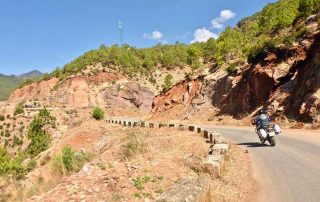
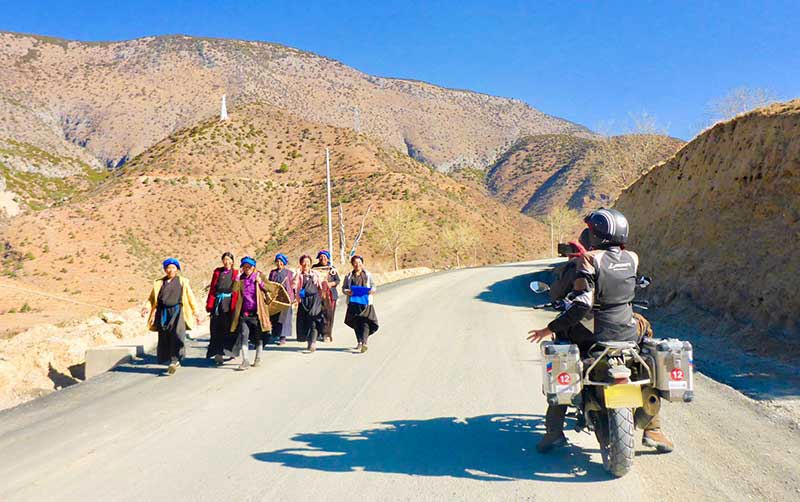
From Shangri-La, we ride through broad grasslands dotted with grazing yaks and continue into evergreen forests toward a 3,700-meter mountain pass. The landscape gradually shifts as we enter the traditional regions of the Naxi and Lisu minorities, where many families still live in simple wooden houses that reflect centuries-old rural life. The winding mountain road, filled with switchbacks and sweeping bends, leads us to the White Water Terraces, where lime-rich water from a sacred spring forms striking white pools cascading down the hillside.

Read more

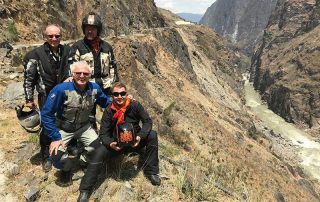
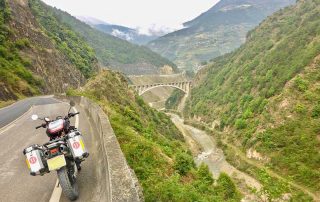
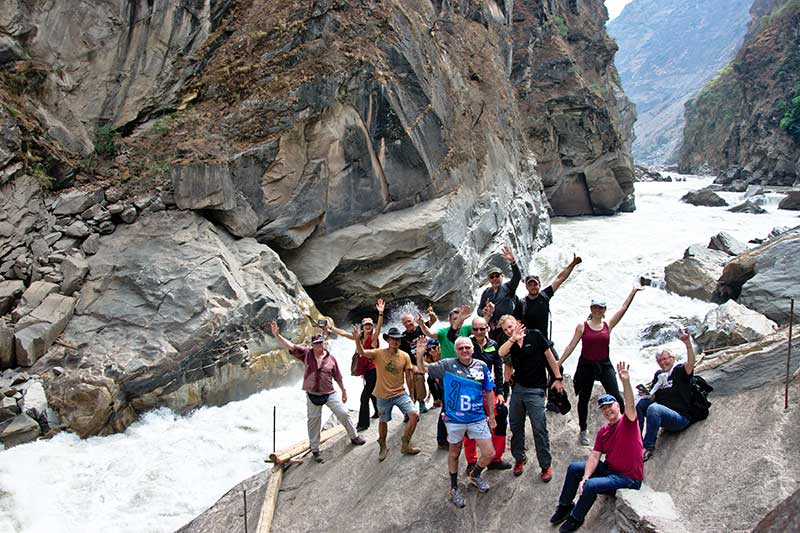
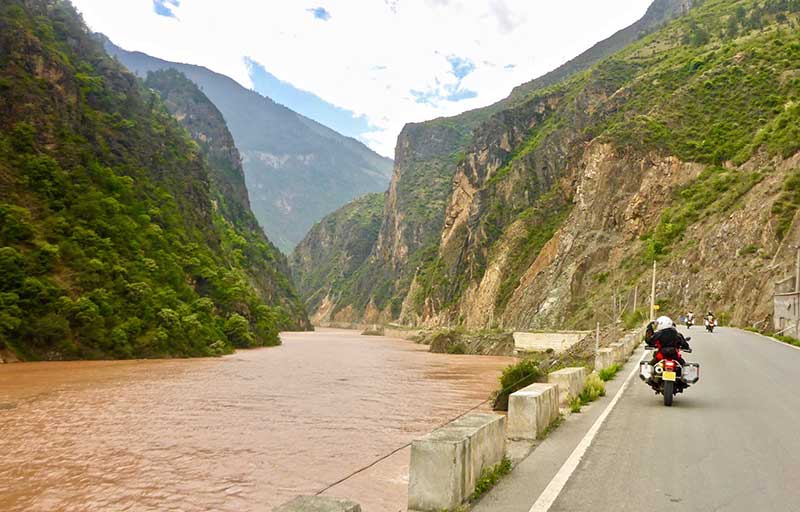
We soon reach the foothills of the 5,396-meter Haba Snow Mountain, its snow-covered peak rising sharply above the valley. From here, a long descent takes us into the dramatic Tiger Leaping Gorge, one of the deepest river canyons on earth. As we drop to around 1,900 meters, the cool mountain air gives way to a warm, subtropical climate — banana trees, cacti and lush vegetation suddenly appear along the roadside. Towering above us is the Jade Dragon Snow Mountain massif, with cliffs soaring nearly 3,000 meters straight up from the river, creating an unforgettable, almost unreal panorama. The narrow cliff-hugging road, not secured by crash barriers, winds along sheer rock walls and offers constant views into the roaring gorge below.
In the early afternoon, after settling into our guesthouse, we take an optional hike down to the legendary Tiger Leaping Stone, reached by a small suspension bridge over the thundering Yangtze. The steep ladders on the return climb add a touch of adventure to the experience. Those who prefer a quieter afternoon can simply relax and decompress with a cool beer on the terrace and take in the dramatic scenery.
Tonight, we stay in a cozy guesthouse inside Tiger Leaping Gorge, surrounded by some of the most breathtaking canyon landscapes in China.

Distance covered: approx. 190 km

Day 3: Onwards through the cliff village at the Yangtze to the fantastic alpine Lugu Lake

The cliff village we visit today was founded in the 7th century atop an almost inaccessible rock ledge, chosen for its natural defences against plundering Tibetan raiders and river pirates. From this extraordinary perch, we enjoy sweeping views of the shimmering bluish-green Yangtze River and the narrow canyon it carves through the mountains. Reaching the village is a true highlight of the tour: the route winds through tiny remote hamlets, where rural Naxi life continues largely unchanged, and follows narrow country lanes that alternate with steep, single-lane mountain roads.

Read more

By late morning, we tackle an exciting descent along a rugged track leading down to the Yangtze itself, surrounded by dramatic cliff walls and deep valley scenery. The final approach into the stone village feels like stepping back in time.

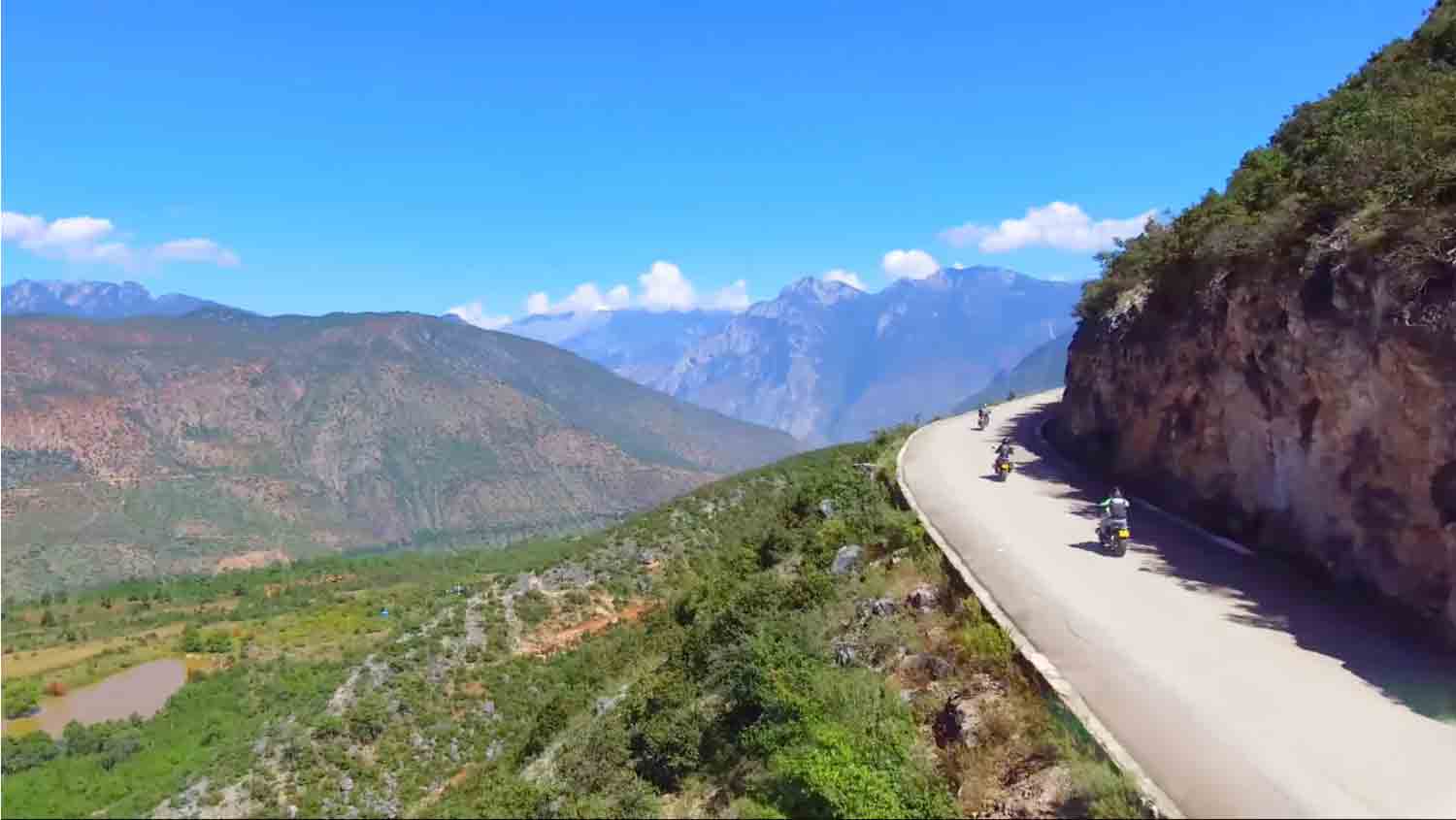
We experience the warm hospitality of the local Naxi people with a lunch stop in the village before we continue riding along the upper Yangtze River, crossing it via a spectacular bridge and ascending toward a nearly 4,000-meter mountain pass. The entire afternoon unfolds on quiet, virtually deserted alpine roads — a paradise for motorcyclists. Long sweeping bends and high viewpoints offer constant panoramas of deep valleys, rugged peaks and dramatic highland landscapes.

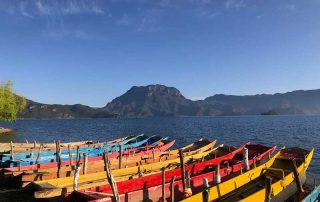
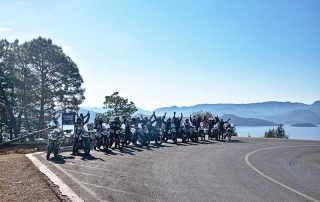
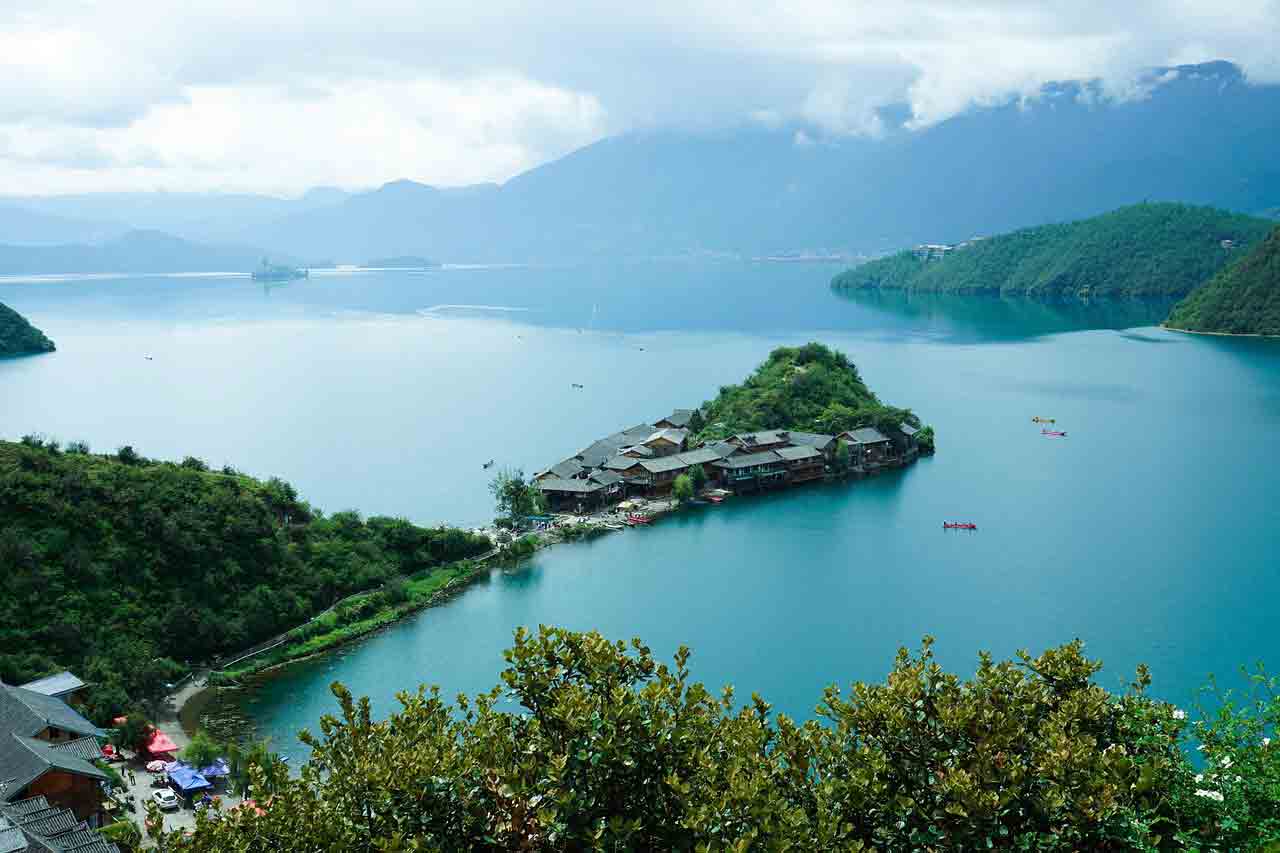
By late afternoon, we reach Lugu Lake, set at an altitude of 2,700 meters and surrounded by dense evergreen forests. Its clear, turquoise waters and serene mountain backdrop create one of the most picturesque overnight stops of the tour. We stay near the lakeshore with beautiful views of the water, and small wooden rowboats are available for those who wish to explore the lake’s islands.

This region is home to the Mosu people, one of the last matriarchal societies in the world, known for their unique cultural traditions and lakeside villages. The shoreline is dotted with small Buddhist temples, tranquil walking paths and several short sandy beaches — a perfect place to unwind after a full day on the mountain roads.

Distance covered: approx. 290 km

Snake Buddha statue at Likir Monastery
On our way to Fatu La Pass

Day 4: The Jade Dragon Snow mountain and the UNESCO World Heritage Site of Lijiang

Today’s ride takes us from the high-altitude shores of Lugu Lake, surrounded by alpine forests and the lands of the Mosu and Yi minorities, down through a dramatic series of valleys and rolling mountain landscapes toward Lijiang. The route offers flowing bends, sweeping viewpoints, and constant changes in elevation as we descend from nearly 2,700 meters into the warmer, subtropical foothills.

Read more

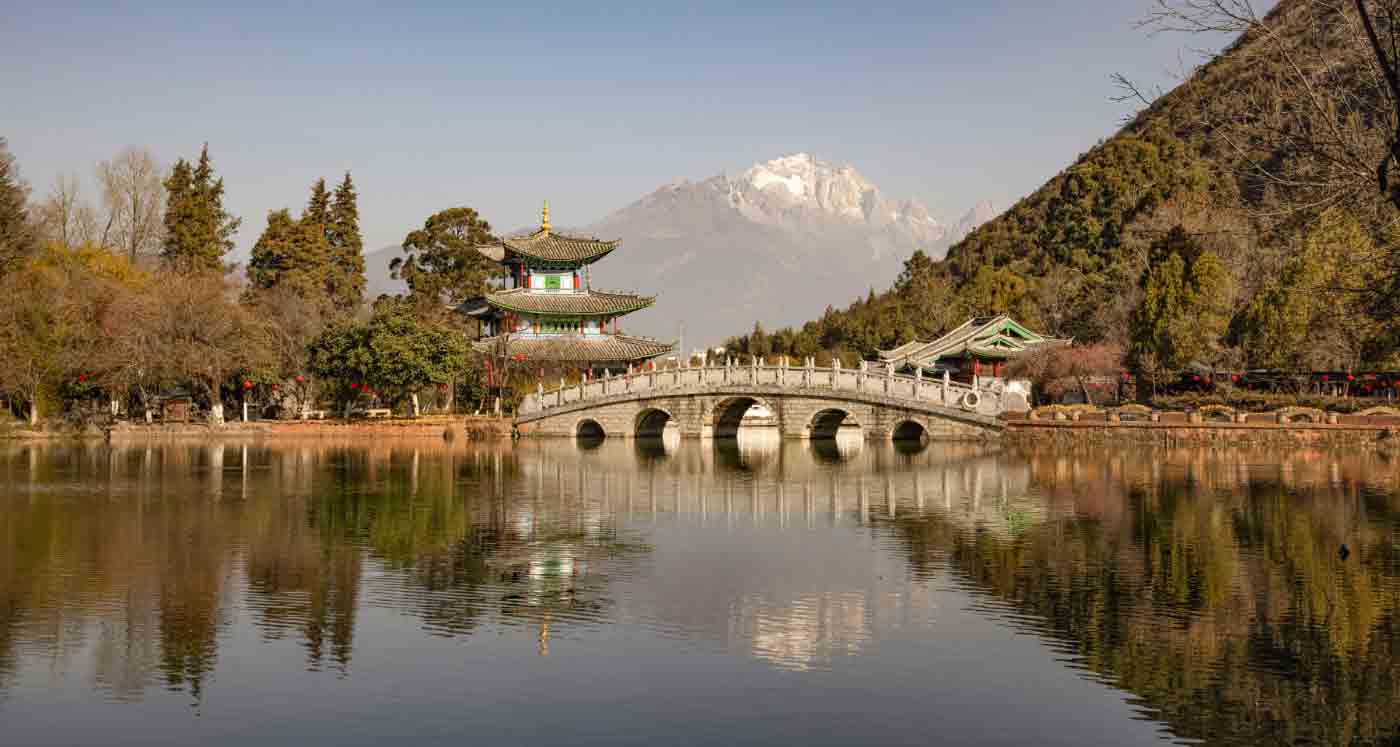
We arrive in the UNESCO World Heritage city of Lijiang with plenty of time to park our bikes and decompress before wandering through its charming alleys, relaxing in small teahouses, or admiring views of the towering Jade Dragon Snow Mountain that rises dramatically behind the valley. We will also have the option to visit the iconic Black Dragon Pool – a landmark of Southwestern China.

In the evening, Lijiang’s many small bars and teahouses compete for our attention, inviting us to enjoy local drinks and the lively yet relaxed atmosphere of this UNESCO-listed mountain town.

Distance covered: approx. 220 km

Day 5: The Nanzhao Kingdom near Dali

We begin the day riding across the wide Lijiang plateau, enjoying open views before descending toward the banks of the upper Yangtze River. Soon we are cruising along quiet rural backroads with very little traffic, winding through small banana groves and tea plantations tended by local farmers — a wonderfully relaxed stretch of our Yunnan motorcycle tour.

Read more

In the afternoon, we reach a charming old town near the 42-kilometer-long Erhai Lake, whose elongated shape has earned it the nickname “ear lake.” From above, and with a bit of imagination, it really does resemble an ear set between the mountains.

We end our day with a short ride into Dali, the former capital of the Nanzhao Kingdom, beautifully situated on the western shore of Erhai at an altitude of 2,200 meters. The town is framed by the eleven rugged 4,100-meter peaks of the Cangshan Mountains, creating a dramatic natural backdrop.

Distance covered: Approx. 290 km

Across the water to Chilling
Khardung La Pass in the Indian Himalayas

Day 6: Sightseeing in Dali

Today is all about exploring Dali, also known as the Most Romantic Ancient Town in China. In the morning, we have the optional excursion to the ancient Chonsheng Three Pagodas, a 1,200-year-old Buddhist temple complex, followed by lunch nearby.

Read more

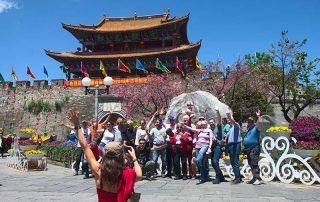
We then have a free afternoon where you have the opportunity to enjoy your time at your leisure. You can stroll through the Dali Ancient Town and visit the majestic city gates showcasing beautiful traditional architecture shaped by Feng Shui philosophy,  or take the cable car up to Cangshan Mountain, or simply ditch the map and wander around. With a multitude of things to see and do, Dali is the perfect place to enjoy your own style of sightseeing and make the most of your rest day.

In the evening, we reconvene and have dinner together, sharing our experiences and delving into tomorrow’s adventure.

Day 7: Following the Tea Horse road to Shaxi

The remote mountain road leading to Shaxi is wonderfully twisty and scenic, taking us past small rural villages and colorful rice and grain fields. Our ride continues to Shibaoshan — the “Stone Treasure Mountain” — home to some of the oldest stone carvings in southern China. These ancient sculptures and impressive Taoist temples carved directly into the cliffs show how prosperous, well-connected and culturally significant this region already was more than 1,200 years ago.

Read more

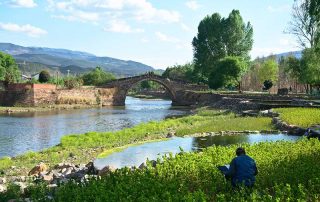
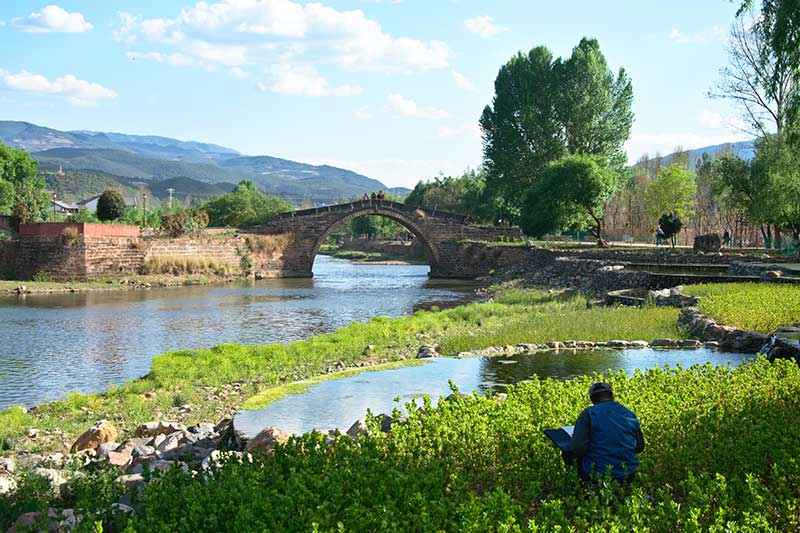
Shaxi is a beautifully preserved historic town along the ancient Tea Horse Road, the legendary trade route that once linked China with Myanmar and India. Chinese merchants traded silk, while traders from the south transported tea over high Himalayan passes, forming one of the most important caravan networks in Asia. Much of that history is still visible today: Shaxi’s wooden old town, the graceful arched stone bridge, and the central village square with its traditional wooden theatre stage all reflect centuries of cultural exchange. We take a walk through the old town and visit a beautifully preserved Qing Dynasty courtyard house, offering a glimpse into the region’s architectural heritage.

Distance covered: approx. 210 km

Camel ride in the dunes at Diskit
View of Lake Pangong

Day 8: Into the Salween valley

Today we ride toward one of the most remote and dramatic regions of our journey. In the afternoon, we reach the mighty Salween River — known in China as the Nu Jiang — a 2,815-kilometer river that cuts through some of the steepest and wildest gorges in Asia. The road follows the river closely, winding through towering canyon walls and rugged mountains as the Salween rushes south from the Tibetan Himalayas toward Myanmar, Thailand and eventually the Andaman Sea. The landscape becomes increasingly raw and powerful, offering a taste of true expedition riding deep in southwestern China.

Distance covered: approx. 300 km

Day 9: Riding along the Salween in the Tibetan Himalayas

We continue following the Salween River northward, riding parallel to the Myanmar border through a landscape of steep cliffs, narrow valleys and powerful river currents. Along the way, we make several scenic photo stops, with plenty of opportunities to take in the raw beauty of the Tibetan Himalayan foothills.

Today’s highlight is the spectacular view of the first great loop of the Salween, where the river bends dramatically as it drops from the high plateau toward the lowlands. As we ride, the road gradually gains altitude, and by the end of the day we are back at nearly 2,000 meters — deep in the mountains and very close to the Tibetan border.

Distance covered: approx. 290 km

Motorcycling along the banks of Lake Pangong
At the Chang La Pass

Day 10: Visiting a Tibetan family on the Mekong

Today we cross a remote, nameless 3,870-meter pass that links the Salween valley with the Mekong gorge. This region belongs to the Three Parallel Rivers of Yunnan — the Yangtze, Salween and Mekong — a vast nature reserve and UNESCO World Heritage Site known for its dramatic topography and exceptional biodiversity.

Read more

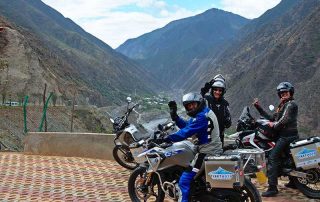
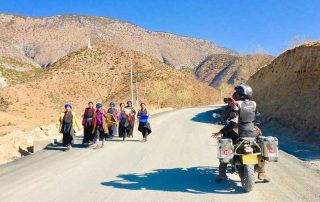
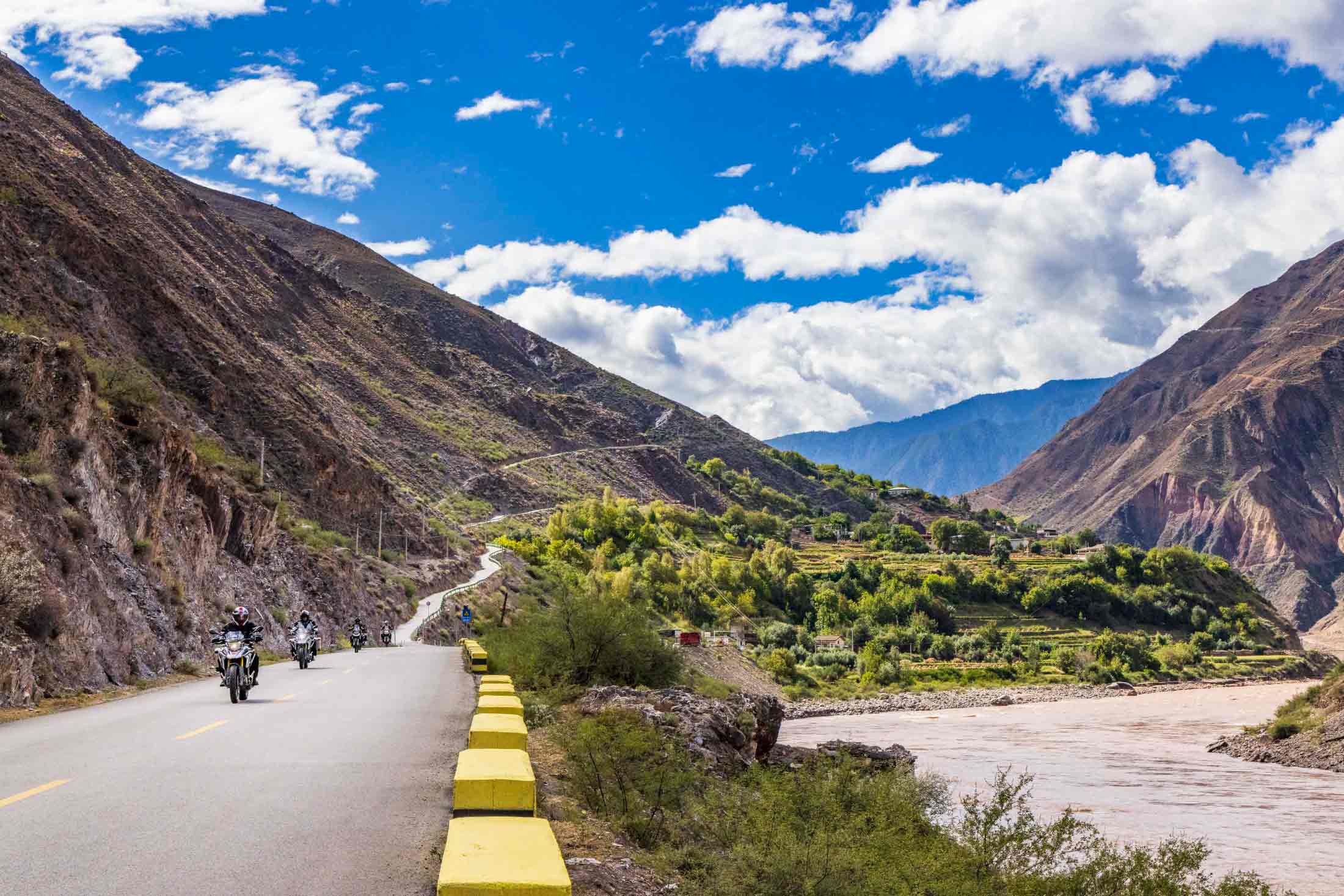
The road across the pass is brand new. Some sections are not completely paved, adding a touch of adventure to the ride. The descent is breathtaking, offering sweeping views of snow-covered Himalayan peaks and rugged mountain faces. On the far side of the pass, we enter the spectacular gorges of the upper Mekong, where the landscape becomes steeper, narrower and more intensely Tibetan.

In a small riverside village shaded by ancient walnut trees, a local Tibetan family welcomes us into their traditional farmhouse — a genuine highlight of the tour. Nestled in a lush green oasis, the home offers warm hospitality, regional dishes and even homemade wheat brandy and red wine for dinner.

From the rooftop terrace, we enjoy unforgettable views of Kawa Karpo (6,740 m), one of the most sacred and imposing peaks in the eastern Himalayas. A short walk to a saddle above the village provides another sweeping vantage point over the Mekong and the surrounding mountains. The time spent with our hosts offers unique insight into everyday Tibetan life and culture — an experience you simply cannot find anywhere else.

Distance covered: approx. 140 km

Day 11: The Mekong, Kawa Karpo & The Pass of The White Horse

On our final day riding back towards Shangri-La, lots of experiences still await us.

Today, we approach one of the absolute highlights of the entire journey. Riding along remote tracks and through narrow Himalayan gorges, we enjoy ever-changing views of Kawa Karpo — the awe-inspiring 6,740-meter peak revered as the “king” of the eastern Himalayas. The mountain dominates the skyline as we travel deeper into the upper Mekong region, and before long we reach the impressive Mingyong Glacier, which descends directly from Kawa Karpo’s summit. Our team knows the best, largely uncharted routes in this remote area, giving us extraordinary vantage points that few visitors ever experience.

Read more

Kawa Karpo is one of the three most sacred mountains in Tibetan Buddhism. In special pilgrimage years, thousands of Tibetans journey here to circumambulate the mountain on an arduous, week-long kora — one of the most demanding and spiritually significant treks in the Himalayas.

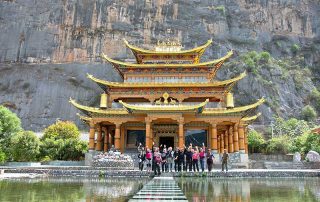
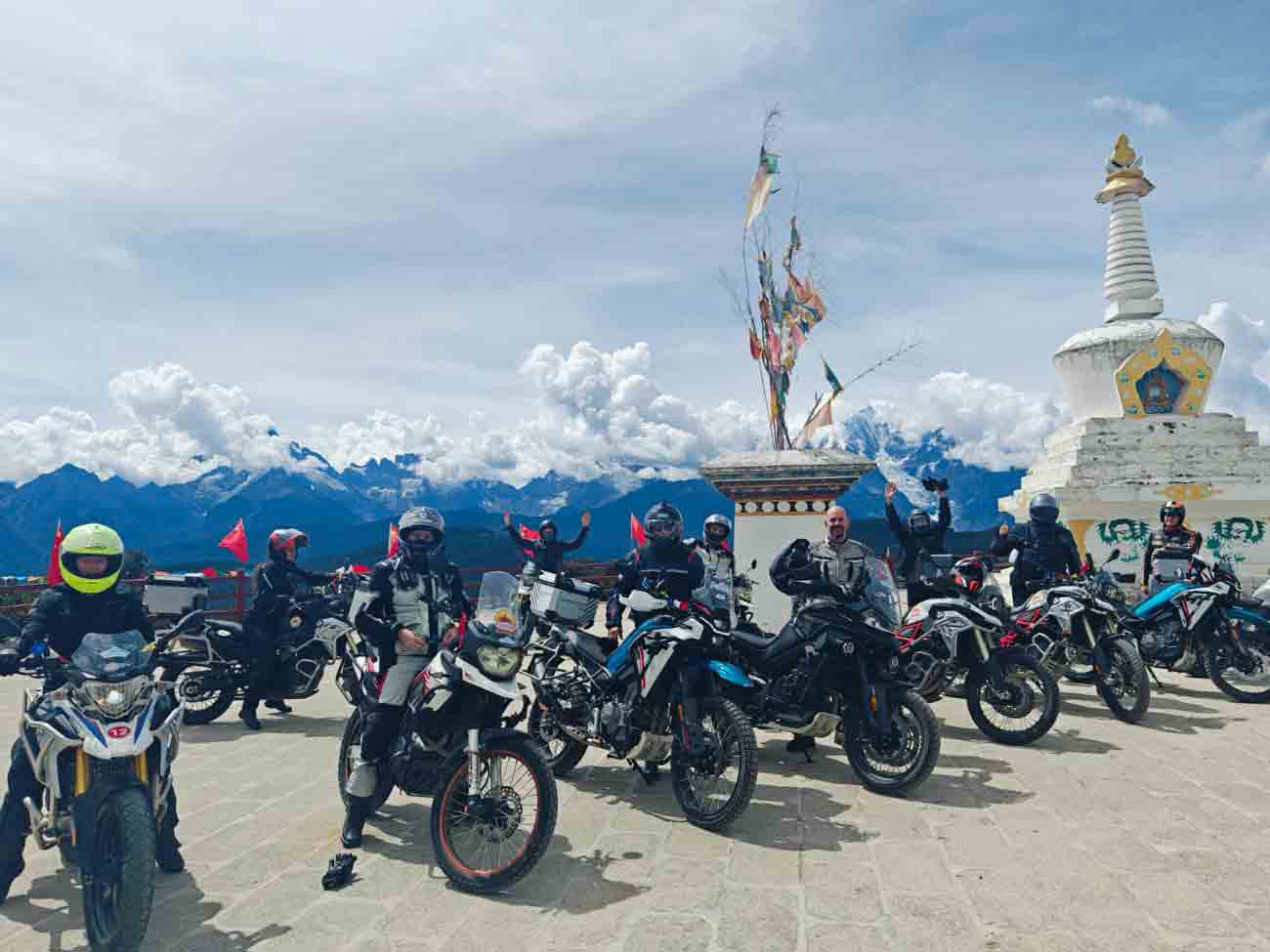
After taking in the glacier and its sacred surroundings, we continue riding through the high mountains toward the Pass of the White Horse — at 4,292 meters, the highest pass of the entire tour. The road offers hundreds of sweeping bends and dramatic Himalayan scenery. On the descent, we stop at a remote Buddhist monastery hidden deep in the mountains, a peaceful final encounter with Tibetan culture.

Our journey concludes as we return to Shangri-La, rolling back into the atmospheric wooden alleys of Dukezong Old Town, where our Himalayan adventure first began.

Distance covered: approx. 320 km

Lake Tso Moriri

Day 12: Goodbye, and have a safe trip home!

Today, we organise your transfer to the airport — either in Shangri-La or Lijiang, depending on your onward travel plans. With unforgettable memories of Himalayan passes, ancient towns and remote river valleys, it’s time to say goodbye and begin your journey home.

Don’t Miss Out On a Wonderful Experience

Book your Tour Now -South of the Clouds Tour

We can accommodate only 14 motorbikes on this tour.

Since our tours get filled up fast, please book our South of the Clouds Tour now to avoid disappointment.

Our Next available tours are as follows:

2026
14.11. – 25.11.

2027
13.11. – 24.11.

Included Services

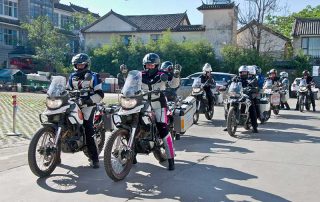
  • English-speaking guide on their own motorcycle
  • English-speaking licensed Tibet guide
  • Mechanic service throughout the journey
  • Support vehicle for luggage and passenger
  • All overnight stays in selected mid-range hotels and guesthouses
  • Motorcycle of your choice, partial comprehensive insurance with deductible
  • Gasoline for the motorcycle, wear parts
  • Breakfast, lunch, dinner, mineral water throughout the tour, soft drinks with meals
  • All entrance fees to attractions noted in the tour itinerary (except for the free afternoon in Dali)
  • All Airport transfers

Excluded Services

  • Domestic and International flights
  • Alcoholic drinks
  • Gratuities (optional)

Questions & Answers

What do I need to bring along for a motorcycle tour?2020-01-06T11:30:46+00:00

You will definitely want to bring your riding suit with protectors and a helmet. You will also need motorcycle boots or lighter riding shoes and gloves. While your gear should be breathable in hot climates, you need to be ready for anything at high altitudes and in the Himalayas. We recommend winter gloves, warm socks, liners for jackets and trousers, a scarf and face protection. Rain gear is a good idea if your riding suit is not waterproof.
Please note that we do not hire out clothing. We believe that your own riding gear will fit best and thus give you the best protection. If you forget anything, we’ll find a solution, however. We often have spare gear with us, or we can point you in the direction of a shop.

Do I need travel insurance and travel health insurance?2019-12-18T06:24:21+00:00

We always recommend that you take out travel insurance to cover costs incurred if you need to cancel the trip due to illness or other reasons. When shopping for travel health insurance, make sure the policy covers the potentially high cost of medical evacuation to your home country. Both forms of insurance can save you a lot of money in an emergency and we recommend them unreservedly. In many countries, your national motoring organization can provide the coverage you need.

What should I keep in mind when riding with a passenger?2019-12-18T06:24:20+00:00

Riding two-up is almost always possible. In difficult terrain or on rough tracks, every passenger has a guaranteed seat in the support vehicle to keep things relaxed for both rider and pillion.

Do pillion passengers have a guaranteed seat in the support vehicle?2019-12-18T06:24:16+00:00

Yes, all passengers have a guaranteed seat. In bad weather or challenging riding conditions, they can switch to the support vehicle at any time – and back to the bike when conditions improve.

How big are the groups? What’s the minimum number of participants?2019-12-18T06:24:15+00:00

Groups generally consist of 8 to 14 riders and 2 to 6 passengers. The minimum number of participants is 6 riders.

What’s the Classic Bike Adventure travel team like?2022-04-14T10:41:11+00:00

Our European tour guides are skilled motorcyclists and inveterate travelers who love India. They’re resilient in the face of stress and know the history and culture of the regions they cover. Our Indian mechanics are experienced Enfield specialists who all speak English and are happy to help with any technical problem, great or small.
A stand-in rider is always available. More information on our travel concept is available here.

What do I need in the way of documents?2019-12-18T06:24:09+00:00

You will need your passport, national driving license, international driving license and flight ticket. Please be sure to make photocopies of all of your important travel documents and carry them separately. They can be invaluable in an emergency.

Do I need a driving license?2019-12-18T06:24:05+00:00

All riders must have a valid motorcycle driving license issued in their home country. An international driving license is also required. Be sure to contact the relevant authorities in your home country well in advance for more information on obtaining an international driving license.

Will I need maps?2019-12-18T06:31:37+00:00

Simple street maps are often available locally. The best road maps are available from the German publishers Reise Know How and Nelles. These are only available in specialized bookstores or online.

Where can I stow my bags?2019-12-18T06:24:02+00:00

Your baggage will be carried by the support vehicle. Please don’t pack too much – remember: less is more. From time to time, we’ll have to carry our baggage over short distances to the hotel. Baggage is not insured, so please be sure to purchase your own baggage insurance for the trip if necessary. Your personal items for the day are best kept in the saddlebags or your daypack. Tank bags – including magnetic ones – can be used on the Enfields, but we don’t provide them.

What’s a typical day on the road like?2019-12-18T06:22:49+00:00

A travel day normally begins at 8 am with breakfast. Around 9 am, after a short briefing by the road captain, it’s time for the day’s riding, the mileage of which can vary quite a bit. Plenty of time will be available for lunch and coffee breaks, of course. Depending on the day’s mileage, we’ll reach the destination hotel between 3 and 4 pm.
Since our tours vary considerably, we may also hit the road at 8 am on high-mileage days – which is also nice, because then we have the whole day ahead of us.

What kind of bikes will we ride?2019-12-18T06:26:11+00:00

Depending on the specific tour, the following bikes are available for our motorcycle tours in Tibet and China: The BMW models G 310 GS, F 800 GS and R 1200GS, as well as the Shineray X5, a 400cc single-cylinder enduro.

How much is the deposit for the bike on China and Tibet tours?2019-12-18T06:26:03+00:00

The deposit for the motorcycle varies depending on the choice of bike:
Shineray X5 400: EUR/US$ 500
BMW G 310 GS: EUR/US$ 1,000
BMW F 800 GS and R 1200 GS: EUR/US$ 1,500

Do I need a chinese visa?2024-09-15T09:54:50+00:00

Entry/Visa:

Many nationalities can enter China visa free for up to 15 days. Those include:
Germany, France, Italy, The Netherlands, Spain, Malaysia, Switzerland, Ireland, Hungary, Austria, Belgium, Luxembourg, New Zealand, Australia, Poland.

Your passport must be valid for at least 6 months. Some other nationalities need a visa to enter China.

Should the duration of the stay exceed 15 days, you must apply for the visa yourself or hire an agency to do so. Due to frequent changes in the application procedure, we recommend using an agency. Although you can apply for the visa yourself, it is only slightly more expensive to hire an agency and often saves a lot of work. The visa for China costs approximately EUR 300. More detailed information on the visa can be found in a specific appendix after booking upon request.
Tour Concept by RC Hendrik